This volume is part of the Practical Guide Series developed and published by the ISA, the International Society for Measurement and Control. The Practical Guides were conceived because of a shortage of published material in the field of measurement and control that bridges the gap between theory and actual industrial practice. Many books in the field have catered to the needs of technical students, who need to be oriented to basic control theory and concepts, or college-level readers, who are interested in engineering mainly from a classroom perspective. There are handbooks for practicing engineers that cover measurement and control, but these handbooks often devote only a chapter or two to topics that merit more attention. Within the Practical Guides Series, separate volumes address each of the important topics and give them comprehensive, book-length treatments. Each book in the series can be understood and used by technical students, sales engineers, sales personnel, and managers, and relied upon by those who have "real-live" industrial concerns such as correct application, safety, installation, and maintenance. Another unique feature of the Practical Guides is the stress placed on the actual experience of measurement and control practitioners. The Practical Guides are overseen by various Volume Editors and a Series Technical Editor, who have extensive experience in measurement and control. The Volume Editors have been selected for their specific expertise in the volume topics, and bring together numerous Contributing Writers with even more specialized knowledge. The Series Technical Editor, who is responsible for general technical consistency within each volume and across all volumes, helps guide the Volume Editors. The Practical Guides capture the hard-earned experience of the writers and, by employing examples and recording anecdotal observations, make that experience as applicable for the reader as possible. Case studies, either hypothetical or based on real case histories, are used to illustrate typical situations and show how good planning and practical applications made the difference between success and failure. Some of this information has never been documented before. This volume is designed to be at home in a library, in a classroom, or on the plant floor. The comfortable reading style, large pages, and frequent illustrations will contribute to ease of use. The page design uses graphics to "call out" some of the major points of the text, such as crucial safety checks and important examples. Each Practical Guide gathers widely scattered information in a single text, with bibliographies directing the reader to other sources. |
 TABLE OF CONTENTS
 Chapter 10.23 - Control Valve Features: Evaluating the Need for Bypass and Block Valves
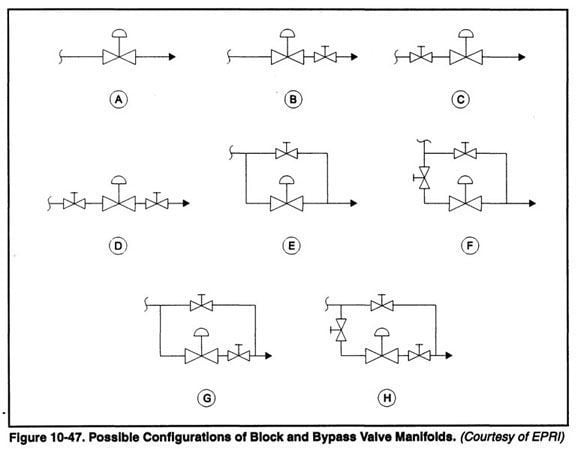
Evaluating the Need for Bypass and Block Valves The purpose of a bypass and block valve assembly is to permit production to continue when a component of the control loop (including the control valve) becomes inoperable. The control valve and any line mounted flowmeters are the only components in the control loop that are in intimate contact with the process medium and cannot be maintained while in service. Most other components (e.g., transmitters, controllers, etc.) can be bypassed or removed for a short period and maintained as required. The control valve cannot be removed unless special installation provisions are established early in the design. The engineer must ensure that the plant integrity is properly protected with appropriate maintenance procedures to permit plant operation within the desired process parameters. If the process, or a portion of it, can be shut down easily, then it may not be necessary to include special features. Assuming the process can be placed in a recycle mode or otherwise idled, it may be sufficient to provide only block and drain valves to assist with the control valve removal. However if the valve is essential for continuous operation, then it will be necessary to install a full bypass and block valve manifold to permit continued manual operation while the valve is out for necessary maintenance. This highlights the need to review the maintenance strategy at the earliest possible time in design, as the ramifications impact piping design and application of other equipment. To summarize, bypass valves are needed when:
 |  Occasionally a manual valve may be installed as a control valve bypass for reasons other than to facilitate control valve maintenance. One example is the installation of a bypass valve larger than the control valve to permit quicker start-up. |