This volume is part of the Practical Guide Series developed and published by the ISA, the International Society for Measurement and Control. The Practical Guides were conceived because of a shortage of published material in the field of measurement and control that bridges the gap between theory and actual industrial practice. Many books in the field have catered to the needs of technical students, who need to be oriented to basic control theory and concepts, or college-level readers, who are interested in engineering mainly from a classroom perspective. There are handbooks for practicing engineers that cover measurement and control, but these handbooks often devote only a chapter or two to topics that merit more attention. Within the Practical Guides Series, separate volumes address each of the important topics and give them comprehensive, book-length treatments. Each book in the series can be understood and used by technical students, sales engineers, sales personnel, and managers, and relied upon by those who have "real-live" industrial concerns such as correct application, safety, installation, and maintenance. Another unique feature of the Practical Guides is the stress placed on the actual experience of measurement and control practitioners. The Practical Guides are overseen by various Volume Editors and a Series Technical Editor, who have extensive experience in measurement and control. The Volume Editors have been selected for their specific expertise in the volume topics, and bring together numerous Contributing Writers with even more specialized knowledge. The Series Technical Editor, who is responsible for general technical consistency within each volume and across all volumes, helps guide the Volume Editors. The Practical Guides capture the hard-earned experience of the writers and, by employing examples and recording anecdotal observations, make that experience as applicable for the reader as possible. Case studies, either hypothetical or based on real case histories, are used to illustrate typical situations and show how good planning and practical applications made the difference between success and failure. Some of this information has never been documented before. This volume is designed to be at home in a library, in a classroom, or on the plant floor. The comfortable reading style, large pages, and frequent illustrations will contribute to ease of use. The page design uses graphics to "call out" some of the major points of the text, such as crucial safety checks and important examples. Each Practical Guide gathers widely scattered information in a single text, with bibliographies directing the reader to other sources. |
 TABLE OF CONTENTS
 Chapter 18 - Case Histories
As you read through the problems described in the case histories in this chapter find out why the problems occurred and see if the solution given seems reasonable. You may avoid making a similar mistake. A book published in the 1980s by Henry Petroski entitled To Engineer is Human had the interesting subtitle The Role of Failure in Successful Design. The author highly recommends that engineering curricula include a course on "engineering failures" so students can learn from the errors of previous generations. Not all the case histories described in this chapter used the wrong valve, but if something goes wrong in a control loop the valve is often the first thing to be blamed. Some of the following case histories are taken from magazine articles, some are tales from longtime associates, some are from this author's personal experience, and some are from this book's other authors. In canvassing for case histories, I got the impression that many who "may" have had control valve problems were reluctant to admit errors! Specification and Selection Snuffing Steam In a coal-fired power plant, auxiliary steam is reduced in pressure and temperature so as to be available for snuffing steam to the coal pulverizers. Powdered coal in these pulverizers and the ducting to the boiler has a bad habit of . spontaneously combusting. Steam is usually the least expensive and most dependable snuffing medium for extinguishing such a fire. The vendor recommended a three-way blending valve (see Figure 18-1) with auxiliary steam entering one port and desuperheating water entering the other. When the vendor was questioned as to how water could enter if the plug was open all the way for steam entry (therefore closed for the water entry port), he hemmed and hawed. Since the valve was already in production, the steam is expected to be used for emergencies only, and high-quality desuperheating is not necessary, the vendor was asked to omit the seat ring from the water entry port. Wrong valve? Definitely. Sales reps are not experts in all applications. The control systems engineer was not an experienced valve man. A better solution: use a combination pressure reducing-desuperheating valve (see Figure 18-2, lower scheme). 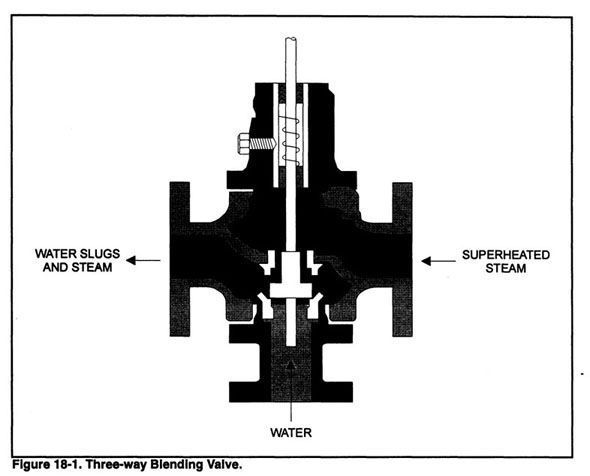 |