This volume is part of the Practical Guide Series developed and published by the ISA, the International Society for Measurement and Control. The Practical Guides were conceived because of a shortage of published material in the field of measurement and control that bridges the gap between theory and actual industrial practice. Many books in the field have catered to the needs of technical students, who need to be oriented to basic control theory and concepts, or college-level readers, who are interested in engineering mainly from a classroom perspective. There are handbooks for practicing engineers that cover measurement and control, but these handbooks often devote only a chapter or two to topics that merit more attention. Within the Practical Guides Series, separate volumes address each of the important topics and give them comprehensive, book-length treatments. Each book in the series can be understood and used by technical students, sales engineers, sales personnel, and managers, and relied upon by those who have "real-live" industrial concerns such as correct application, safety, installation, and maintenance. Another unique feature of the Practical Guides is the stress placed on the actual experience of measurement and control practitioners. The Practical Guides are overseen by various Volume Editors and a Series Technical Editor, who have extensive experience in measurement and control. The Volume Editors have been selected for their specific expertise in the volume topics, and bring together numerous Contributing Writers with even more specialized knowledge. The Series Technical Editor, who is responsible for general technical consistency within each volume and across all volumes, helps guide the Volume Editors. The Practical Guides capture the hard-earned experience of the writers and, by employing examples and recording anecdotal observations, make that experience as applicable for the reader as possible. Case studies, either hypothetical or based on real case histories, are used to illustrate typical situations and show how good planning and practical applications made the difference between success and failure. Some of this information has never been documented before. This volume is designed to be at home in a library, in a classroom, or on the plant floor. The comfortable reading style, large pages, and frequent illustrations will contribute to ease of use. The page design uses graphics to "call out" some of the major points of the text, such as crucial safety checks and important examples. Each Practical Guide gathers widely scattered information in a single text, with bibliographies directing the reader to other sources. |
 TABLE OF CONTENTS
 Chapter 20 - Control Valve Testing
Valves are first tested by their maker, before shipment, and later by their user, in the field. This chapter discusses both these aspects of testing. The first part of the chapter deals with the routine, common, and less common control valve tests performed by manufacturers; the second covers the process of testing after the control valve is installed. Part One: Manufacturer's Testing Control valve testing by manufacturers is important because it helps a user get a high-quality valve that will perform its intended function. Before tests are performed, however, the user and manufacturer must understand what tests are needed, how they are to be performed, how they are to be documented, how they should be interpreted, and when they should be accepted or rejected. This chapter provides information on standard and specialized tests to help in that process. With this information, the control valve user can be more confident that the valve will work as desired, and the manufacturer will be helped by knowing what is required before the valve is quoted and built. This chapter deals specifically with tests performed by valve manufacturers or by others for manufacturers. Organizations that rebuild control valves may also perform some of the tests. Their test capabilities may be more limited, however, and normally consist of routine testing. This chapter discusses the general information needed to perform any test and more specific information needed for other various types of tests. Routine tests, commonly requested tests, and less common tests required for specific applications will all be discussed. Where tests are already covered by industry standards, those standards are identified but not described in detail. See Appendix C of this volume for a bibliography of control valve standards. For tests not covered by standards, important considerations are discussed in more detail. General Information Needed for any Test To perform any test, the manufacturer must know the test procedure, acceptance criteria, what documentation is required, and whether an inspector must be present during the test. If an inspector is required, the manufacturer must also know at what points in the manufacture of the valve he needs to be present. Except for routine tests, the ideal time for the customer to specify these items is by inquiring before the valve is quoted and ordered. This allows the manufacturer to understand the test requirements and work out any problems before quoting the valve. The manufacturer can then design any special features required in the valve and arrange for special equipment that may be required to perform the tests. For a standard test, the procedure, acceptance criteria, and required documentation will be specified in a common industry standard. The user then only has to decide if and when he needs an inspector. Of course, if the customer needs any testing beyond what the standard requires, he must communicate that to the manufacturer. Tests not described by standards must be defined. This is normally done by user specifications or by the manufacturer's procedures, which are reviewed and approved by the user. In some cases, the user and manufacturer may have to define the details of the tests together. This is often most efficiently accomplished by meeting and discussing the issues prior to the order and definitely before the manufacturing process has begun. With the increased emphasis placed on quality worldwide, a series of international standards has been developed by the International Organization for Standardization (ISO) to help improve quality. This series of standards is designated ISO 9000, ISO 9001, ISO 9002, ISO 9003, and ISO 9004. They are discussed in more detail in Chapter 21. They deal with the documentation of the procedures used to assure quality products or services. They include requirements to control, to calibrate, and to maintain inspection, measuring, and test equipment. Users may want to familiarize themselves with these standards and consider requiring that the control valve manufacturer follow them as they pertain to the tests outlined in this chapter. A necessary part of any test is the communication of the test results. This can be done with a formal report or with simple test certificates. Test procedures should identify the test data that must be provided and often how they are to be provided. Table 20-1 lists the key elements of a good certificate. 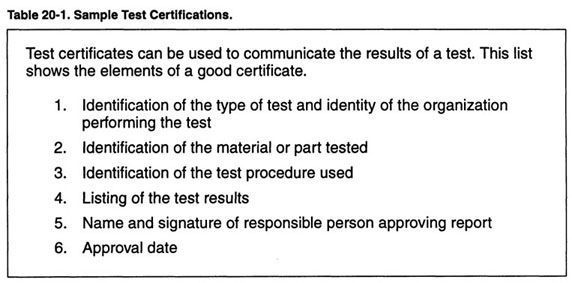 |