This volume is part of the Practical Guide Series developed and published by the ISA, the International Society for Measurement and Control. The Practical Guides were conceived because of a shortage of published material in the field of measurement and control that bridges the gap between theory and actual industrial practice. Many books in the field have catered to the needs of technical students, who need to be oriented to basic control theory and concepts, or college-level readers, who are interested in engineering mainly from a classroom perspective. There are handbooks for practicing engineers that cover measurement and control, but these handbooks often devote only a chapter or two to topics that merit more attention. Within the Practical Guides Series, separate volumes address each of the important topics and give them comprehensive, book-length treatments. Each book in the series can be understood and used by technical students, sales engineers, sales personnel, and managers, and relied upon by those who have "real-live" industrial concerns such as correct application, safety, installation, and maintenance. Another unique feature of the Practical Guides is the stress placed on the actual experience of measurement and control practitioners. The Practical Guides are overseen by various Volume Editors and a Series Technical Editor, who have extensive experience in measurement and control. The Volume Editors have been selected for their specific expertise in the volume topics, and bring together numerous Contributing Writers with even more specialized knowledge. The Series Technical Editor, who is responsible for general technical consistency within each volume and across all volumes, helps guide the Volume Editors. The Practical Guides capture the hard-earned experience of the writers and, by employing examples and recording anecdotal observations, make that experience as applicable for the reader as possible. Case studies, either hypothetical or based on real case histories, are used to illustrate typical situations and show how good planning and practical applications made the difference between success and failure. Some of this information has never been documented before. This volume is designed to be at home in a library, in a classroom, or on the plant floor. The comfortable reading style, large pages, and frequent illustrations will contribute to ease of use. The page design uses graphics to "call out" some of the major points of the text, such as crucial safety checks and important examples. Each Practical Guide gathers widely scattered information in a single text, with bibliographies directing the reader to other sources. |
 TABLE OF CONTENTS
 Chapter 10.22 - Control Valve Features: Fire Safe Treatment
Fire Safe Treatment The concern for valve and actuator performance during a fire has brought about many interesting valve designs. The interest for fire safe valves is highest in petroleum and chemical plants. However, power plants, gas or oil fired, must also be concerned with fire safe treatment of valves. Everywhere fire-caused valve failure could cause increased damage or jeopardize life, the engineer must analyze valve action and specify safe shutdown or opening of process lines. Fire safety extends beyond the valve itself; the actuator may have to resist fire damage for at least one cycle even if it cannot be made as durable as the valve. Then to, a single actuation may not be sufficient. It is conceivable that a valve may have to be actuated several times during or directly after a fire. Actuators have been designed to survive a certain amount of fire resistance. Of course, this assumes that the external control system is also fire resistant, which involves air lines and coincident wiring, small valves and relays. Routine inspection is necessary if the enclosure is to be ready at all times. Fire safe valves are designed to service hazardous or flammable fluids, gases and other critical media. One fire safe butterfly design (Figure 10-44) features triple duty sealing. There is a resilient insert for bubble tight sealing under normal conditions. This metal-to-metal sealing provides positive shutoff during and after a fire, even with partial soft-seal destruction. The temperature range is -100F to 450F with pressures to 1480 psi; shutoff bubble tight per MSS SP-61. 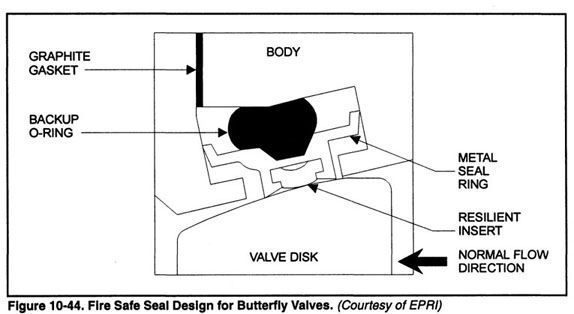 Spring-driven actuators, triggered by fusible-link arrangements at the first indication of a fire, are available to actuate quarter turn valves. Floating-ball valves with TFE seat rings are now common in fire safe designs. Valves to be qualified as "fire-safe" must be subjected to rigorous tests. These tests vary in methodology and intensity. They take into account such matters as: how a fire begins and progresses in a particular service, what the particular process fluid is, what the temperature is during the critical part of the fire, how tight the valve should seal and what the post-fire capability of the valve must be. 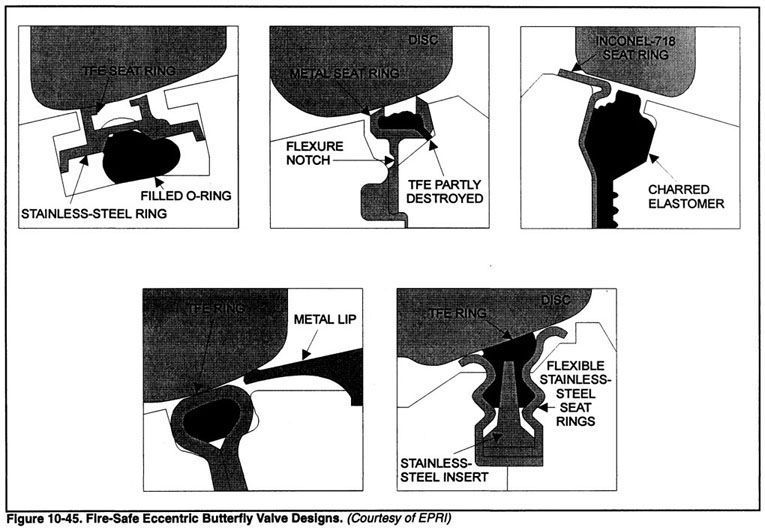 Fire Safe Pneumatic Actuators with Fusible Elements In high temperature or fire safe applications standard construction spring-return actuators may be used to provide one spring stroke if the following are considered:
In applications where a standard pneumatic actuator is adequate to meet the above requirements, the actuator may be fitted with a fusible plug to respond to a fire. The fusible plug, like the fusible link, is a zinc and lead blend that melts at a specific temperature. A tee fitting is installed on the actuator pressure inlet port and the branch of the tee is fitted with a fusible plug. When exposed to a fire, the plug melts and represents a break in the air-supply line which exhausts air pressure from the actuator and provides for the necessary spring action. If the temperature at which the air-supply line break is to occur is not critical, some users elect to install the air system using polypropylene tubing which melts when exposed to fire. 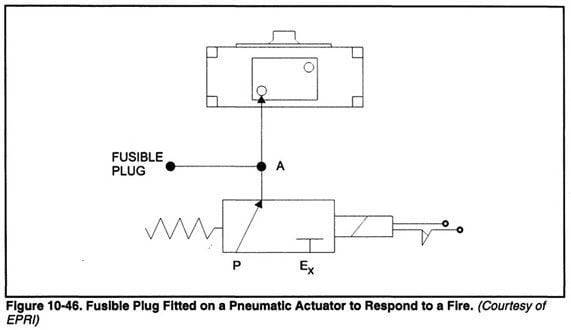 For simple, fail safe action, each of the previously discussed systems can meet some or all of the requirements for some fire-safe systems. In some applications, where it may be necessary to cycle a valve during or after exposure to a catastrophic fire condition Actuator manufacturers offer two different systems for use:
|