Geometrical Dimensioning and Tolerancing for Design, Manufacturing and Inspection: A Handbook for Geometrical Product Specification using ISO and ASME Standards, Second Edition
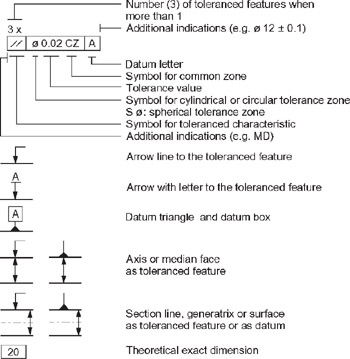
The symbols for the drawing indications of geometrical tolerances according to ISO 1101, ISO 5459, ISO 286 and ISO 10579 are shown in Tables 3.1 and 3.2.
| Symbol | Interpretation |
|---|---|
|
![]() | |
|
![]() | |
| | Envelope requirement |
| | Maximum material requirement |
| | Least material requirement |
| | Reciprocity requirement |
| | Projected tolerance zone |
| | Flexible part in free state |
| | Regardless of feature size (ASME Y14.5) |
| | Tangent method (ASME Y14.5) |
| | Unsymmetrical tolerance zone (ASME Y14.8) |
| MD | Applies to major diameter of threads, splines, gears |
| PD | Applies to pitch diameter of threads, splines, gears |
| LD | Applies to (least) minor diameter of threads, splines, gears |
| LE | Applies to line elements (section lines) |
| NC | Not convex |
| ACS | Any cross-section |
| Further symbols are planned according to ISO 14 405 (in preparation) |
|
![]() |
Table 3.2 shows the symbols for the geometrical tolerance characteristics.
With the symbols of the left column of Table 3.2 all kinds of geometrical tolerances can be expressed. The symbols of the right column cover special cases that occur very frequently. These symbols are standardized in addition, and should be used in order to facilitate readability of drawings.
The proportions of the symbols for the drawing indications are standardized in ISO 7083. However, some CAD systems deviate from this standard. This may be tolerable as long as the drawing indications are unambiguous (as demonstrated in this book).
In order to specify geometrical tolerances, the workpiece is considered to be composed of features (geometrical...