Geometrical Dimensioning and Tolerancing for Design, Manufacturing and Inspection: A Handbook for Geometrical Product Specification using ISO and ASME Standards, Second Edition
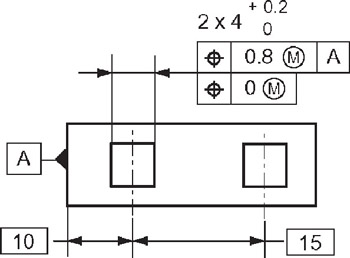
Geometrical dimensioning and tolerancing (GD&T) are function related when the functional requirements are directly indicated and toleranced (Fig. 19.1). Then the largest tolerances appear.
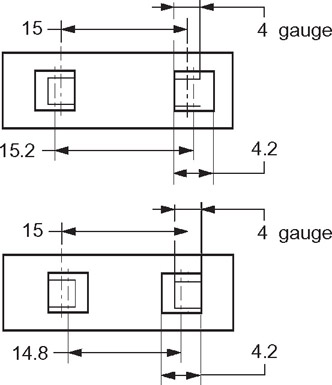
Figure 19.2 shows extreme cases of the permissible workpiece shape according to GD&T of Fig. 19.1. A gauge of width 4 and centre distance 15 must fit into the workpiece.
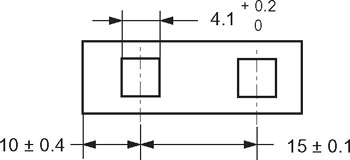
GD&T are manufacturing related when the dimensions and tolerances that are to be adjusted during manufacturing are directly indicated (there is no need for the worker to calculate) and when these tolerances can be respected by the intended manufacturing process (Fig. 19.3). This is the easiest way to control the manufacturing process. However, the functional requirements, the function-related tolerances, must not be violated. If function-related GD&T and manufacturing-related GD&T do not coincide, the functional requirements are indicated indirectly. This leads to a reduction (decrease) in the tolerances.
For example, according to Fig. 19.3, the centre distance must not exceed 15.1, but with function-related GD&T, according to Fig. 19.1, the centre distance may be 15.2 when the actual size (more precisely, the mating size) of the slot is 4.2.
Figures 19.4 and 19.5 demonstrate how the tolerances are derived from the function-related GD&T of Fig. 19.1 by considering extreme cases. The workpiece must not violate the limits (maximum material...