Geometrical Dimensioning and Tolerancing for Design, Manufacturing and Inspection: A Handbook for Geometrical Product Specification using ISO and ASME Standards, Second Edition

The positional tolerance is defined in ISO 1101 and positional tolerancing is described in ISO 5458.
In the method of positional tolerancing (for the location of features) theoretical exact dimensions and positional tolerances determine the location of features (points, axes, median faces and plane surfaces) relative to each other or in relation to one or more datum(s). The tolerance zone is symmetrically disposed about the theoretical exact location.
By virtue of this definition positional tolerances do not accumulate where theoretical exact dimensions are arranged in a chain (Figs 6.1, 6.2 and 18.55). This contrasts with dimensional tolerances arranged in a chain.
According to ISO 1101 theoretical exact dimensions are to be indicated in rectangular frames. However, the following theoretical exact dimensions that determine the theoretical exact locations of positional tolerance zones are not to be indicated:
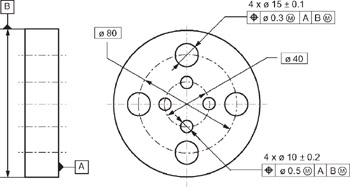
theoretical exact angles between features (e.g. holes) equally spaced on a complete pitch circle (Figs 6.4 and 6.5); and
Figure 6.4: Positional toleranced features (holes) equally spaced on a complete pitch circle, drawn on the same centre line, and therefore regarded as related features having the same theoretical exact location
theoretical exact dimensions 90 and 0 , 180 or distance 0 (features located theoretically on a straight line) between
positional toleranced features not related to a datum (Figs 6.2, 20.19 and 20.70),
positional toleranced features related to the same datum(s) (Figs 3.24 and 6.4),
positional toleranced features...