Geometrical Dimensioning and Tolerancing for Design, Manufacturing and Inspection: A Handbook for Geometrical Product Specification using ISO and ASME Standards, Second Edition

The envelope requirement according to ISO 8015 specifies that the surface of a single feature of size (cylindrical surface or a feature established by two parallel opposite plane surfaces) should not violate the imaginary envelope of perfect (geometrical ideal) form at maximum material size.
The envelope requirement may be specified either
by indication of the symbol
placed after the linear (size) tolerance, when applicable to a selected individual feature;
by indication in the drawing title box "ISO 2768 -E", when applicable to all features of size in addition to the general geometrical tolerances according to ISO 2768;
by a national standard, e.g. ASME Y14.5M or DIN 7167, when applicable to all features of size.
The envelope requirement cannot be applied to features for which a straightness or flatness tolerance is specified that is larger than the size tolerance. According to ASME Y14.5M, the envelope requirement also does not apply to features for which a straightness tolerance of the axis (even if smaller than the size tolerance) is specified.
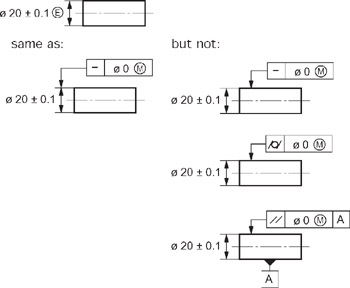
The envelope requirement may also be indicated by a form tolerance with 0
applied, see 9.3.4. However, it is rather difficult to find the proper drawing indication (Fig. 10.1). Therefore the symbol
has been standardized in ISO 8015.
The envelope requirement is applicable to single features of size (cylindrical surfaces or features established by two parallel opposite plane surfaces).
The envelope requirement...