Geometrical Dimensioning and Tolerancing for Design, Manufacturing and Inspection: A Handbook for Geometrical Product Specification using ISO and ASME Standards, Second Edition

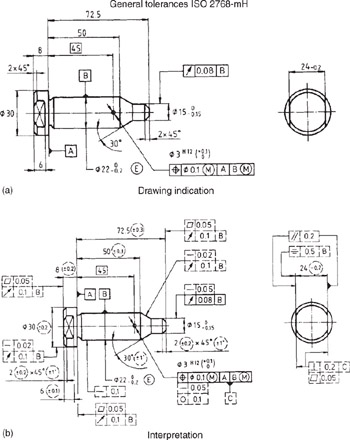
As the principle of independency demands an indication for each requirement, it calls for the application of a standard on general geometrical tolerances (title block tolerances on geometry). Otherwise, the drawing would be embroidered with geometrical tolerance indications (Fig. 16.11).
Tolerances shown in dashed lines (boxes and circles) are general tolerances according to ISO 2768-mH which will be automatically respected by machining in a workshop with a customary accuracy equal to or finer than ISO 2768-mH and would not normally require to be inspected.
Even if Rule #1 of ASME Y14.5M (see 21.1.2) is used, there is still a need for general geometrical tolerances on orientation (perpendicularity) and location (coaxiality and symmetry), because Rule #1 does not apply to related features. Furthermore, there is a need for general geometrical tolerances on form for single features to which a disclaimer from Rule #1 is indicated.
Before applying general tolerances, their concept must be agreed upon. This concept has been developed in the International Organization for Standardization (ISO), as follows (ISO 2768):
Each feature requires limits for its deviations determined by its function.
The drawing must be definitive, i.e. the drawing must specify all dimensional and geometrical tolerances necessary to completely define the shape and size of the part.
Above certain values of tolerances, there is generally no gain in economy by increasing them further. These tolerances are not exceeded in normal workshop practice...