With the arithmetical tolerance line-up calculation (worst case tolerancing), the tolerances of the links of the dimension chain (e.g. single parts of an assembly) are defined in such a way that the assembly still functions when all links of the chain have actual sizes equal to their limits of size (Fig. 14.1).
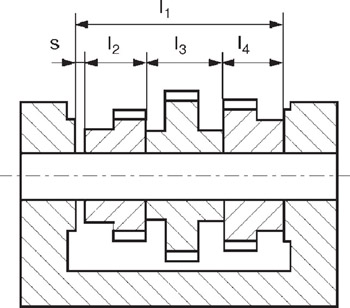 Figure 14.1: Assembly with required clearance s (functional closing tolerance T)
 However, in practice the actual sizes are subject to variations, and are therefore statistically distributed (e.g. according to a normal distribution) (Figs 14.2 and 14.3). With this supposition, it is most unlikely that an assembly contains only parts with actual sizes equal to the limits of size (Fig. 14.4).
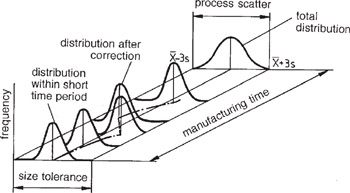 Figure 14.2: Distribution of actual sizes during a manufacturing process
 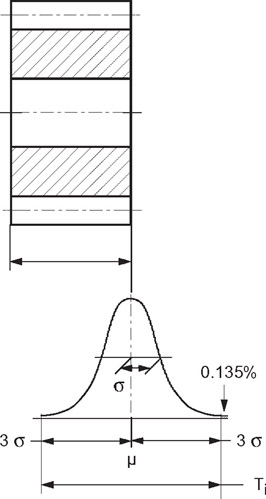 Figure 14.3: Distribution of actual sizes (size deviations) of a part
 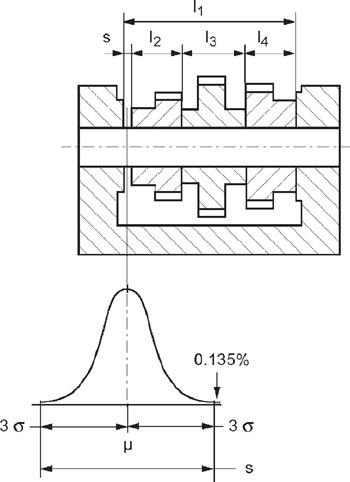 Figure 14.4: Distribution of actual values of the closing dimension (clearance)
 In contrast to the arithmetical tolerance line-up calculation, in the statistical tolerance line-up calculation it is assumed that this extreme case will not occur. The single tolerances are chosen larger than with arithmetical tolerancing.
The variability ? s of the clearance or interference, i.e. functional closing tolerance T of the assembly derives from n single tolerances with arithmetical tolerancing according to
with statistical tolerancing according to
With arithmetical tolerancing, the single tolerance is T/4 = 0.25 T. With statistical tolerancing, the single tolerance is T/ ?4 = 0.5 T. Non-functioning occurs when the arithmetical sum of the...
Copyright Georg Henzold 2006 under license agreement with Books24x7

 TABLE OF CONTENTS