For tolerancing the geometry (sharpness) of edges (within cross-sections) a separate standard ISO 13 715 has been developed. Edges are intersections of two surfaces. Edges always exhibit deviations from the ideal geometrical shape (burr or undercut or passing) (Fig. 22.1). The size of these deviations may be necessary to be toleranced for functional reasons (e.g. in hydraulic equipment) or out of safety considerations.
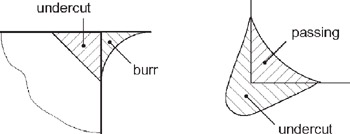 Figure 22.1: Edge deviations
 Burr is a rough remainder of material outside the ideal geometrical shape of an external edge, or a residue of machining or of a forming process (Fig. 22.1).
Undercut is a deviation inside the ideal geometrical shape of an internal or external edge (Fig. 22.1).
Passing is a deviation outside the ideal geometrical shape of an internal edge (Fig. 22.1).
The size a of the edge deviation is illustrated in Fig. 22.2.
 Figure 22.2: Sizes of edge deviations
 The tolerances for the deviations from the ideal geometrical shape of edges within cross-sections are to be indicated by the symbol shown in Fig. 22.3.
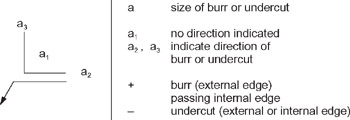 Figure 22.3: Symbol for edge tolerances
 The indication + at the symbol means only deviations outside the material of geometrical ideal form are allowed (burr or passing permitted, undercut not permitted) (Fig. 22.5).
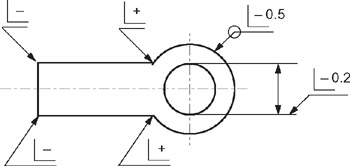 Figure 22.5: Examples of indication of an edge tolerance applied to all edges around the profile on both sides, front and back; applied to the edge of a feature (hole); applied to edges vertical to the projection plane and without tolerance value
 The...
Copyright Georg Henzold 2006 under license agreement with Books24x7

 TABLE OF CONTENTS