Geometrical Dimensioning and Tolerancing for Design, Manufacturing and Inspection: A Handbook for Geometrical Product Specification using ISO and ASME Standards, Second Edition
Substitute elements (substitute features) are imaginary geometrical ideal features (e.g. straight line, circle, plane, cylinder, sphere, cone and torus). Their location, orientation and (if applicable) size are calculated from the assessed points of the workpiece surface.
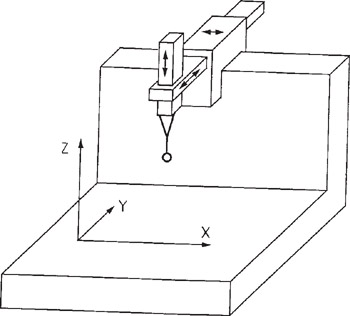
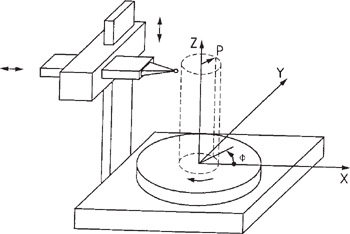
In general, substitute elements are assessed by coordinate measuring machines or form measuring machines. According to the planned ISO Standard on VD&T, the assessment is performed in a right-handed Cartesian (rectangular) coordinate system (Fig. 8.1), or a right-handed cylindrical coordinate system (Fig. 8.2).
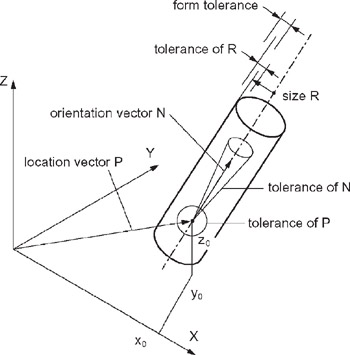
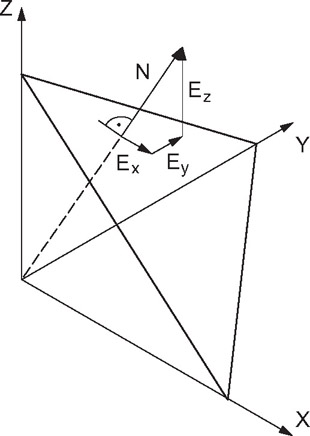
Points in space are defined by their coordinates x 0, y 0, z 0 (location vector P) and stored for further data processing (Fig. 8.3). Orientations in space are defined by the components E x, E y, E z of the unit vector (orientation vector N or E). It therefore follows that N = ? ( E x 2 + E y 2 + E z 2) = 1 (Figs 8.3 and 8.4). The orientation vector is always directed out of the material.
Table 8.1 shows the vectors needed to define the substitute element. The indicated minimum numbers of points to be assessed apply to geometrical ideal features. As the actual features always exhibit form deviations,...