When workpieces are fitted together, size deviations accumulate. In order to assess the resulting clearance or interference, tolerance line-up calculations are performed. Arithmetical tolerance calculations are based on extreme cases (worst cases) when all sizes are at their favourable or unfavourable limit of size. Statistical tolerance calculations take into account the form of distribution of the actual sizes and give the clearance or interference that will not be exceeded with a certain statistical probability (see 14). The procedure for an arithmetical tolerance line-up calculation is as follows:
-
define the dimension scheme, showing all dimensions and their tolerances that form the chain, i.e. all dimensions that contribute to the clearance or interference;
-
dimensions whose upper limits lead to an increase in the closing dimension are drawn in the positive direction, and others in the negative direction;
-
the arithmetical sum of the maximum limits of size of the positive chain links and the minimum limits of size of the negative chain links, gives the maximum value of the closing dimension (maximum clearance, minimum interference). See Fig. 13.1.
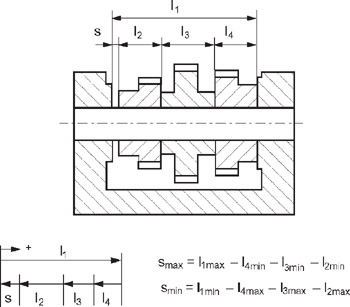 Figure 13.1: Arithmetical tolerance line-up calculation
 The arithmetical sum of the minimum limits of size of the positive chain links and the maximum limits of size of the negative chain links, gives the minimum value of the closing dimension (minimum clearance, maximum interference) (Fig. 13.1).
Instead of the limits of size, the permissible deviations may be taken when the arithmetical sum of the nominal sizes is zero.
The tolerance line-up calculation according to...
Copyright Georg Henzold 2006 under license agreement with Books24x7

 TABLE OF CONTENTS