Geometrical Dimensioning and Tolerancing for Design, Manufacturing and Inspection: A Handbook for Geometrical Product Specification using ISO and ASME Standards, Second Edition
ISO aims to give mathematically exact definitions of the constituents of the geometrical specifications in order to give a sound foundation for
unambiguous drawing specifications;
programming of measurement instruments;
estimation of measurement uncertainties.
All geometrical specifications deal with features. Their definitions were an issue of intensive discussions within ISO.
According to ISO 14 660-1, ISO TS 17 450-1 and ISO 22 432-1:
(Single) feature geometric entity which is a single point, a single line, or a single surface, e.g. a cylinder.
Compound feature geometric entity which is a collection of features, e.g. two parallel opposite planes connected by a size dimension.
According to ASME Y14.5:
Feature physical portion of a part, such as a surface, pin, tab or slot.
The meaning of a drawing indication remains the same despite the different definitions of a feature.
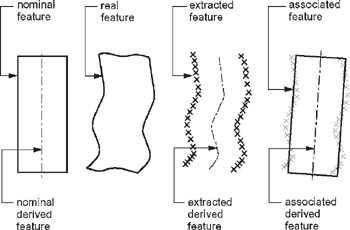
ISO 14 660-1 defines
nominal feature (of ideal geometry according to the drawing);
real feature (of non-ideal geometry as existing on the workpiece);
extracted feature (of non-ideal geometry as detected from the workpiece);
associated feature (of ideal geometry and fitted to the extracted feature according to an objective function (fitting rule, e.g. minimum zone));
see Fig. 23.1.
ISO 22 432 Parts 1 to 6 further describe various types of feature:
ideal feature and non-ideal feature;
integral feature (ideal or non-ideal, surface or line on a feature) and derived feature (centre point, median line or median surface derived...