Geometrical Dimensioning and Tolerancing for Design, Manufacturing and Inspection: A Handbook for Geometrical Product Specification using ISO and ASME Standards, Second Edition

The separation of roughness and waviness from geometrical deviations (form, orientation, location, run-out) is not yet completely internationally standardized.
Normally the peaks of the surface roughness contribute fully to the geometrical deviation. How much the surface roughness valleys contribute to the geometrical deviation depends on the measuring method.
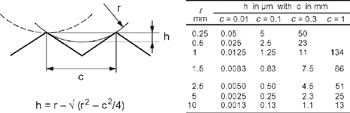
In practice the roughness is filtered out by the effect of the stylus tip (ball) of the measuring instrument (with dial gauges, the ball radius is normally 1.5 mm). The effect on the assessment of the geometrical deviation depending on the ball radius r and on the spacing c of the deviations (irregularities) of the workpiece surface is shown in Fig. 18.110. With surfaces manufactured by metal removal normally the waviness depth W t is smaller than 5 ?m and the waviness spacing wider than 0.3 mm. In these cases the waviness is part of the geometrical deviations. Therefore the corresponding ISO Technical Committee plans to define in an ISO Standard that waviness is part of the geometrical deviations.
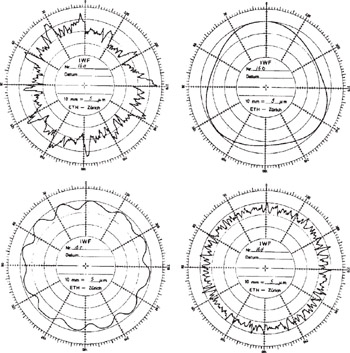
However, for some functions, e.g. the ball race surface on ball bearings, the waviness must be toleranced and measured separately by the use of appropriate filters, see Fig. 18.115.
Form measuring instruments usually allow...