
Shaft Collars Information
Last revised: February 3, 2025
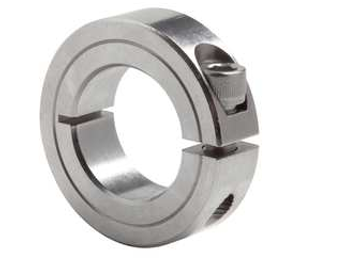
Shaft collars attach to shafts and are used as stop features or targets for devices such as tachometers. They are usually made of aluminum, steel, stainless steel, or alloyed steel and coated with zinc, chromium or black oxide. Shaft collars made from non-metallic materials such as nylon are also available. Generally, these products are used for washdown applications such as food processing.
There are several basic shaft collar designs:
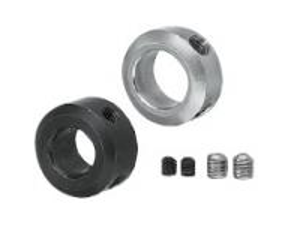
- Setscrew collars are suitable for simple shaft positioning, but are not designed for high axial loads or applications that require repositioning.
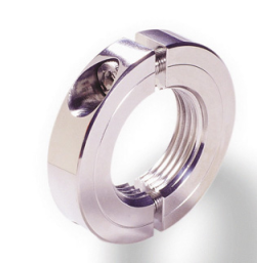
- Threaded clamp collars are designed for threaded shafts and provide a relatively high axial loading force.
- One-piece clamp or C-style collars provide a more uniform holding force on the shaft. Like threaded clamp collars, these devices can be repositioned as necessary.
- Two-piece shaft collars provide a stronger and more uniform holding force than one-piece shaft collars. They also accept greater variances in shaft diameter and can be assembled anywhere on a shaft.
Specifications
Selecting shaft collars requires an analysis of specifications. Products are measured in English units such as inches (in) or metric units such as millimeters (mm) or centimeters (cm).
Thread types include:
- Unified national fine (UNF)
- Unified national coarse (UNC)
- Acme
Important specifications to consider when specifying shaft collars are:
- Width
- Bore diameter
- Outer diameter
- Axial load capacity
Measured in pounds (lbs) or kilograms (kg), axial load capacity is the maximum load that can be applied along or parallel to and concentric with the primary axis. Typically, acme threaded collars can withstand higher thrust loads than conventional smooth bore collars. Some shaft collars include clamping screws that are all inserted from the same direction. Others include clamping screws that are inserted from opposite directions.
Applications and Industries
Shaft collars are used in a variety of application and industries. Examples include:
- Agricultural implements
- Office machines
- Exercise equipment
- Mixers
- Printing presses
A variety of specialized products are available:
- Knurled shaft collars provide a friction surface for hand gripping and are suitable for conveyors and other applications which require frequent collar adjustment.
- Hexagonal-bore shaft collars are suitable for power transmission and drive applications.
- Heavy-duty shaft collars feature large cross sections and sturdy clamping screws for added holding power. Because heavy-duty shaft collars provide better vibration and shock resistance, they are designed for applications such as off-road, mining, paper and steel mill equipment.
Standards
BS 4185-2 — Specification for Machine Tool Components - Part 2: Collars
Shaft Collars FAQs
How do different types of shaft collars impact the performance and reliability of mechanical systems?
The impact of different types of shaft collars on the performance and reliability of mechanical systems can be significant.
Set Screw Collars
These collars are used to position and retain parts on a shaft. However, they can be bulky and expensive. The set screw can dig into the shaft when tightened, potentially causing damage.
Clamping Collar-Style Hubs
Clamping collars offer easy installation and removal. However, if the fit clearance between the shaft and bore is too large, the hub can become eccentric to the shaft, leading to imbalance or misalignment issues. This can potentially cause driveline failure. Proper shaft fits and screw tightening torques are crucial for optimal performance.
Self-Centering Clamping Systems
These are often used for high-speed or high-power systems. Excessive fit clearance can reduce the transmittable torque of the shaft hub connection. When properly fitted, they offer superior performance compared to simple keyway hubs and are easier to handle than interference fit hubs.
Coiled Pins
While not a collar, coiled pins are used to affix a collar or hub to a shaft. They provide superior performance by preventing hole damage and extending the lifetime of the assembly due to their flexibility and ability to absorb forces.
Each type of shaft collar has its own advantages and potential drawbacks, impacting the mechanical system's performance and reliability differently. Proper selection and installation are key to maximizing their benefits.
What are the advantages of self-centering clamping systems?
Self-centering clamping systems offer several advantages, particularly in high-speed or high-power mechanical systems.
Superior Performance
Self-centering clamping systems provide superior performance compared to simple keyway hubs. They are designed to handle high-speed and high-power applications effectively.
Ease of Handling
These systems are easier to handle than interference fit hubs. This ease of handling can be beneficial during installation and maintenance, reducing the time and effort required.
Reduced Imbalance and Misalignment
Properly fitted self-centering clamping systems help minimize issues related to imbalance and misalignment. This is crucial for maintaining the reliability and efficiency of the mechanical system.
Optimal Torque Transmission
When the fit clearance and screw tightening torques are correctly applied, self-centering clamping systems can optimize the transmittable torque of the shaft hub connection. This ensures that the system can handle the required loads without slipping or failing.
These advantages make self-centering clamping systems a preferred choice in applications where precision and reliability are critical.
How do self-centering clamping systems compare to other types of shaft collars?
Self-centering clamping systems offer distinct advantages compared to other types of shaft collars, particularly in high-speed or high-power applications.
Performance
Self-Centering Clamping Systems: These systems provide superior performance in high-speed and high-power applications. They are designed to handle these conditions effectively, offering better performance than simple keyway hubs.
Set Screw Collars: While they are used to position and retain parts on a shaft, they can cause damage by digging into the shaft when tightened.
Ease of Handling
Self-Centering Clamping Systems: Easier to handle than interference fit hubs, which can be beneficial during installation and maintenance.
Clamping Collar-Style Hubs: Also offer easy installation and removal, but can become eccentric to the shaft if the fit clearance is too large, leading to potential issues.
Alignment and Balance
Self-Centering Clamping Systems: Help minimize imbalance and misalignment issues when properly fitted, which is crucial for maintaining system reliability and efficiency.
Clamping Collar-Style Hubs: Can cause imbalance or misalignment if not properly fitted.
Torque Transmission
Self-Centering Clamping Systems: Optimize the transmittable torque of the shaft hub connection when the fit clearance and screw tightening torques are correctly applied.
Overall, self-centering clamping systems are preferred in applications where precision, reliability, and ease of handling are critical. They offer advantages over other types of shaft collars, particularly in demanding environments.
What are the potential drawbacks of self-centering clamping systems?
Self-centering clamping systems, while offering several advantages, also have potential drawbacks that should be considered.
Fit Clearance Issues
Excessive fit clearance between the shaft and the hub can reduce the transmittable torque of the shaft hub connection. This can lead to performance issues, especially in high-speed or high-power applications where optimal torque transmission is critical.
Installation Precision
The performance of self-centering clamping systems heavily relies on proper installation. This includes ensuring the correct fit clearance and applying the appropriate screw tightening torques. Any deviation from these requirements can lead to imbalance, misalignment, or reduced performance.
These drawbacks highlight the importance of precise installation and maintenance to ensure the optimal performance of self-centering clamping systems. If these factors are not carefully managed, the system may not perform as expected.
How do self-centering clamping systems improve system reliability?
Self-centering clamping systems improve system reliability in several ways, particularly in high-speed or high-power applications. Here are some key points based on the information available:
Minimized Imbalance and Misalignment
Self-centering clamping systems help reduce issues related to imbalance and misalignment when properly fitted. This is crucial for maintaining the reliability and efficiency of the mechanical system, as imbalance and misalignment can lead to premature wear or failure of components.
Optimal Torque Transmission
These systems are designed to optimize the transmittable torque of the shaft hub connection. By ensuring the correct fit clearance and applying the appropriate screw tightening torques, self-centering clamping systems can handle the required loads without slipping or failing, thus enhancing system reliability.
Ease of Handling
Compared to interference fit hubs, self-centering clamping systems are easier to handle, which can reduce the likelihood of installation errors. Proper installation is critical for maintaining system reliability, as any deviation can lead to performance issues.
These factors contribute to the overall reliability of mechanical systems using self-centering clamping systems, making them a preferred choice in applications where precision and reliability are critical.
What are the common applications for set screw collars?
Set screw collars are commonly used to position and retain parts on a shaft. However, they have some limitations, such as being bulky and potentially causing damage to the shaft when the set screw is tightened, as it can dig into the shaft.
What are the advantages and disadvantages of set screw collars?
Set screw collars have both advantages and disadvantages that can impact their use in mechanical systems. Here is a detailed overview based on the information available:
Advantages of Set Screw Collars
Positioning and Retention
Set screw collars are commonly used to position and retain parts on a shaft. They provide a straightforward method for securing components in place.
Disadvantages of Set Screw Collars
Potential for Shaft Damage
One of the main drawbacks is that the set screw can dig into the shaft when tightened. This can cause damage to the shaft, which may lead to issues in the mechanical system.
Bulkiness and Cost
Set screw collars can be bulky and expensive compared to other methods of securing components, such as using a retaining ring.
These factors should be considered when selecting set screw collars for specific applications, as they can influence both the performance and the cost-effectiveness of the mechanical system.
What are the key factors to consider when selecting a shaft collar for a specific application?
When selecting a shaft collar for a specific application, several key factors should be considered to ensure optimal performance and reliability.
Type of Shaft Collar
Set Screw Collars: These are used for positioning and retaining parts on a shaft but can cause shaft damage due to the set screw digging into the shaft. They are also bulky and expensive.
Clamping Collar-Style Hubs: Offer easy installation and removal but can become eccentric to the shaft if the fit clearance is too large, leading to imbalance or misalignment.
Self-Centering Clamping Systems: Provide superior performance in high-speed or high-power applications, minimizing imbalance and misalignment when properly fitted.
Application Requirements
Consider the specific requirements of the application, such as the need for high-speed or high-power handling, which might favor self-centering clamping systems.
Fit Clearance and Torque
Ensure that the fit clearance between the shaft and the collar is appropriate to avoid issues like reduced torque transmission or imbalance. Proper screw tightening torques are also crucial for optimal performance.
Cost and Bulkiness
Evaluate the cost-effectiveness and space constraints of the application. Set screw collars, for example, can be bulky and expensive compared to alternatives like retaining rings.
Ease of Installation and Maintenance
Consider how easy it is to install and maintain the shaft collar. Clamping collar-style hubs and self-centering systems are generally easier to handle than interference fit hubs.
Shaft Collars Media Gallery
References
GlobalSpec—How to select the proper pin for an application
Image credits:
Grainger Industrial Supply | MISUMI USA | Stafford Manufacturing Corp.
- motor shaft coupling
- split collar clamp
- acme threaded rod couplings
- split shaft collar
- large shaft coupling
- threaded shaft
- friction collar
- quick release shaft collars
- tapered shaft collar
- locking shaft collars
- Miller Clamp
- parallel shaft coupling
- thermowell with collar
- threaded rod clamp
- ACME threaded collar
- metric shaft adapters
- two piece clamping collar shaft collar
- 2 piece split collars
- aluminum split collars
- axial load shaft collars
- flanged shaft collars
- hex bore shaft collars
- hinged shaft collars
- miniature shaft collars
- self locking shaft collars
- square shaft collars
- two piece threaded shaft collars