
Vibration Sensors Information
 Vibration sensors are sensors for measuring, displaying, and analyzing linear velocity, displacement and proximity, or acceleration.
Vibration — however subtle and unnoticed by human senses — is a telltale sign of machine condition. Abnormal vibration indicative of problems with an industrial machine can be detected early and repaired before the event of machine failure; because such a failure is potentially costly in terms of time, cost, and productivity, vibration measurement allows industrial plants to increase efficiency and save money. Therefore, vibration analysis is used as a tool to determine equipment condition as well as the specific location and type of problems.
The severity of machine vibration is standardized by the International Standards Organization (ISO) in the ISO 10816 publication. The standard describes acceptable vibration levels for four different classes of machines. This data, as laid out in the chart below, proves useful as a reference point when analyzing vibration measurements.
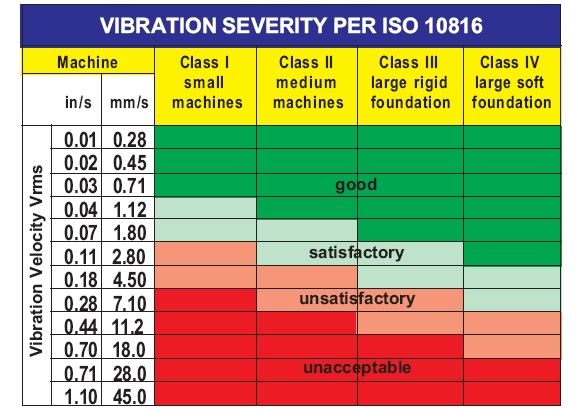 Guide to vibration severity per ISO 10816
Form Factor and Construction
This page classifies various devices — including sensors (or transducers), transmitters, and switches for vibration measurement — under the blanket term "vibration sensor." Many devices which are not nominally considered vibration sensors can be used for vibration measurement; for example, Accelerometers Specification Guide are frequently used to measure vibration as well as acceleration. Basic vibration sensor types are described below.
- Vibration sensors are simply packaged as a raw sensor.
- Vibration transducers are slightly more complex sensors which output a voltage or current signal.
- Vibration transmitters are sensors packaged with the means (such as integral signal conditioners) to transmit a more complex output.
- Vibration switches use an integral sensor to make or break contact when certain vibration levels are detected.
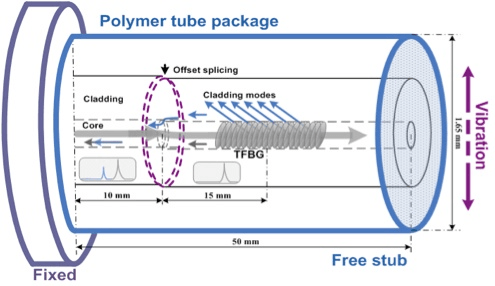
A typical raw vibration sensor. This device would include a connector to allow transmission of an output signal.
The ISO 10816 is one of the most important vibration measurement standards and is described in more detail below.
Applications and Industries
The table below describes the industries which commonly use vibration measurement, as well as the product traits for sensors designed for each. The unique characteristics of each industry determine ideal sensor characteristics; for example, the very slow rotation of turbines in the mining and wind power industries results in the use of a vibration sensor with a very low frequency response of around 1 Hz or less. In contrast, the oil and gas industry requires high frequency (greater than 10 Hz - 10 kHz) sensors to cope with the faster rotation of turbines and gears.
|
Industry |
Frequency |
Physical considerations |
Special features |
|
Food and beverage |
Low |
Small size and profile |
Must be resistant to corrosion from chemicals and cleaning fluids; able to withstand frequent washdown. |
|
Metalworking |
Low |
Robust (to withstand flying debris) |
Corrosion-resistant; high signal-to-noise ratio for detecting defective bearings. |
|
Mining |
Very low |
Robust |
Corrosion-resistant; high signal-to-noise ratio. |
|
Oil and gas |
High |
Varies |
Suitable for hazardous area use; precise monitoring; integral RFI shielding. |
|
Paper |
Low |
Varies |
Temperature-resistant; high signal-to-noise ratio; fluid-resistant. |
|
Portable (specialized) |
Varies |
Small and durable for portability |
Features vary depending on frequency and application. |
|
Power generation |
Higher |
Varies |
Measures both velocity and acceleration; precise sensitivity; RFI shielding for high voltage environments; heat-resistant. |
|
Wind power |
Very low |
Small and compact |
Integral cable and standardized package to simplify installation on many different turbines. |
Standards
Standards related to vibration measurement are published and maintained by numerous standards bodies. Examples of these include:
ISO 4866 -- Mechanical vibration and shock - Vibration of fixed structures - Guidelines for the measurement of vibrations and evaluation of their effects on structures.
AS 2625.1 -- Mechanical vibration - Evaluation of machine vibration by measurements on non-rotating parts Part 1: General guidelines
References
National Instruments - Vibration Sensors
Image credits:
- piezo vibration sensor
- seismic sensor
- geophone
- car vibration sensor
- motor vibration sensors
- wireless vibration sensors
- ICP vibration sensors
- iepe vibration sensors
- intrinsically safe vibration meter
- pipe vibration meters
- 4-20mA vibration sensors
- analog vibration sensors
- bearing vibration sensors
- CSI hand held vibration meters
- electronic vibration sensors
- engine vibration sensors
- gas turbine vibration sensors
- ground vibration sensors
- high temperature vibration sensors
- loop powered vibration sensors
- magnetic vibration sensors
- metrix vibration sensors
- miniature vibration sensors
- mole vibration sensors
- motor shaft vibration sensors
- seismic vibration sensors
- spindle vibration sensors
- USB vibration sensors
- washing machine vibration sensors