Verilog Quickstart: A Practical Guide to Simulation and Synthesis in Verilog, 3rd Edition
Chapter 15: State Machines

STATE MACHINE TYPES

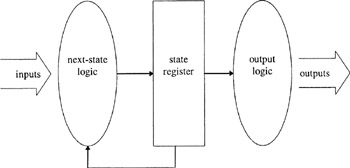
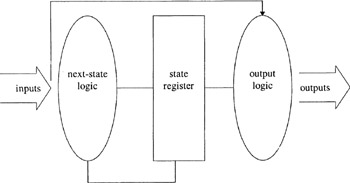
There are two types of state machines: Mealy machines and Moore machines. You can model both types of machines in Verilog. The difference between Mealy and Moore machines is in how outputs are generated. In a Moore machine, the outputs are a function of the current state. This implies that the outputs from the Moore machine are synchronous to the state changes. In a Mealy machine, the outputs are a function of both the state and the inputs.

A state machine can be broken down into three parts: The state register, the next-state logic, and the output logic.

A state machine can be depicted as shown in Figure 15-1.


Figure 15-1: Moore State Machine

Figure 15-1 can be modified to bring the inputs through to the output logic, thus creating a Mealy state machine, as shown in Figure 15-2.


Figure 15-2: Mealy State Machine

To model a state machine in Verilog, you must model each of the three parts of the state machine.

STATE MACHINE MODELING STYLE

Because a state machine is made up of three parts, you have a choice whether to model each section independently, or to try to combine the parts into one section of the model.

Table 15-1 shows some interesting combinations:

Table 15-1: State Machine Styles

Style

State Register

Next-State Logic

Output Logic

1

Separate

Separate

Separate

2

Combined

Combined

Separate

3

Separate

Combined

Combined

4

Combined

Combined

Combined

5

Combined

Separate

Combined

In the first style, each of the functional...

UNLIMITED FREE
ACCESS
TO THE WORLD'S BEST IDEAS

SUBMIT
Already a GlobalSpec user? Log in.

This is embarrasing...

An error occurred while processing the form. Please try again in a few minutes.

Customize Your GlobalSpec Experience

Category: Arithmetic Logic Units (ALU)
Finish!
Privacy Policy

This is embarrasing...

An error occurred while processing the form. Please try again in a few minutes.