
Calipers Information
Last revised: January 14, 2025
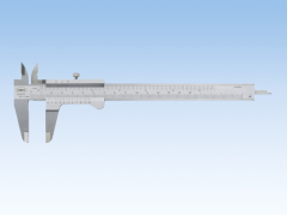
Calipers typically use a precise slide movement for inside, outside, depth or step measurements. Specialized slide type calipers are available for center, depth and gear tooth measurement and gaging machine table travel. Some caliper types such as spring / fay or firm joint calipers do not usually have a graduated scale or display and are used for comparing or transferring dimensions.
Caliper Types
Common types of calipers include:
Center measuring: A center measuring caliper has conically pointed jaws designed to measure the distance between the centers of two holes.
Gear tooth: A gear tooth caliper has an adjustable tongue designed to measure the thickness of gear teeth at the pitch line. The adjustable tongue sets the measurement depth at the pitch line or addendum.
Machine travel: Machine travel calipers are designed to measure the travel or position changes of a machine bed, table, or stage. These gages are typically mounted on a machine or are built into a product including machine tools, microscopes, and other instruments requiring precision dimensional measurement or position control.
Nib jaws: Nib shaped jaws facilitate measurement of inside features (ID), outside features (OD), grooves, slots, keyways or notches. Compared to the blade edge typically found on standard calipers, the nib is more easily and accurately located on an edge or groove. Small, pocket-sized calipers are usually designed for low precision gaging applications.
Pocket or rolling mill: Rolling mill calipers are usually simple rugged devices for quick gaging of stock in production environments.
Slide caliper: Sliding calipers use a precise slide movement for inside, outside, depth or step measurements. While calipers do not typically provide the precision of micrometers, they provide a versatile and broad range of measurement capability: inside (ID), outside (OD), depth, step, thickness and length.
Spring or firm-joint: Spring, Fay, firm-joint or other radially opening type calipers have jaws that swing open with a scissor or plier-type action. These calipers are commonly found in non-graduated versions; although units with graduated, dial, or digital displays are available.
Display Options
The display on calipers can be non-graduated meaning that the caliper has no display, dial or analog display, digital display, column or bargraph display, remote display, graduated scale display, or Vernier scale display.
Specifications
Important specifications for calipers include the range and the graduation or resolution.
- The range covers the total range of length or dimension that the caliper can measure.
- The graduation or resolution is the best or minimum graduations for scaled or dial-indicating instruments, or the best or minimum resolution for gages with digital displays.
- Measurement units for calipers can be either English or metric. Some calipers are configured to measure both.
Features
Common features of calipers include depth attachments or gages and marking capabilities.
A depth attachment is a gage specialized for depth measurements usually consisting of a solid base with a protruding rod or slide. The solid depth base provides a reference and support across the opening.
Marking capabilities include gages that accommodate a scribe or other device for accurately marking a component at a specific measurement along a particular dimension.
Standards
The American National Standards Institute (ANSI) specifies the standard ANSI Z540.3 to establish the technical requirements for the calibration of measuring and test equipment.
Caliper FAQs
How do different types of calipers vary in terms of accuracy and precision for engineering measurements?
When considering the accuracy and precision of different types of calipers for engineering measurements, several factors come into play:
Dial and Vernier Calipers: These are commonly used for mechanical measurements and can achieve accuracy to one mil (0.001 inch). However, they are subject to Abbe offset errors due to the measurement scale being offset from the measurement axis.
Digital Calipers: These offer advantages in terms of accuracy and ease of reading. They can switch between units and set "zero" at any position, which is useful for relative measurements.
Calipers typically read to 0.001 inches, while micrometers can read to 0.0005 inches or better, indicating higher resolution for micrometers.
Calibration is crucial for ensuring the accuracy of measuring devices. The American National Standards Institute (ANSI) specifies standards like ANSI Z540.3 for the calibration of measuring and test equipment.
The field of metrology requires that instruments have an accuracy of 1/10 of the desired precision. For example, dial indicators with 0.1-mil accuracy are used to determine 0.001 inch.
High-accuracy gaging units may use precision linear encoders or laser-based interferometers, which provide very low instrument uncertainties.
What are Abbe offset errors and how do they affect measurements?
Abbe Offset Errors
Abbe offset errors are a type of measurement error that occur when the measurement scale is not aligned with the measurement axis. This misalignment can lead to inaccuracies in the measurement results. The principle behind Abbe offset errors is that to minimize overall measurement error, the sensor and measurement axis must be in line.
Impact on Measurements
Alignment: When the measurement scale is offset from the measurement axis, as is the case with dial calipers, Abbe offset errors can occur. This misalignment can introduce errors in the measurement, affecting the accuracy of the results.
Instrument Design: Instruments like micrometers, where the measurement barrel is in line with the measurement axis, are designed to avoid Abbe offset errors. This design consideration helps ensure more accurate measurements by aligning the measurement scale with the axis.
Measurement Accuracy: The presence of Abbe offset errors can lead to discrepancies between the actual measurement and the true value, which is critical in precision engineering applications where high accuracy is required.
What is the role of calibration in measuring devices?
Calibration is a critical process in ensuring the accuracy and reliability of measuring devices used in engineering and technical fields. Here are some key points about calibration:
Calibration is the process of comparing a measuring instrument's value to a known standard of higher order to establish the instrument's accuracy.
It ensures that the measuring device provides correct readings by aligning it with a recognized standard.
Calibration is essential for precision, as it helps determine the uncertainty in the measuring devices used.
Even if a device has high resolution, it cannot be considered accurate unless it has been calibrated and its error or uncertainty is established.
The American National Standards Institute (ANSI) specifies standards like ANSI Z540.3, which establish the technical requirements for the calibration of measuring and test equipment.
In metrology, the science of measurement, instruments are generally required to have an accuracy of 1/10 of the desired precision. This ensures that measurements are reliable and meet the necessary precision requirements.
High-accuracy gaging units may use technologies like precision linear encoders or laser-based interferometers, which provide very low instrument uncertainties. These technologies are part of the calibration process to ensure the entire unit's accuracy, not just the sensor.
Calibration is a foundational aspect of maintaining the integrity and accuracy of measurements in engineering, ensuring that devices perform as expected and provide reliable data.
How often should measuring devices be calibrated?
The frequency of calibration for measuring devices can depend on several factors, including the type of device, its usage, and the precision required for the measurements. While the documents provided do not specify exact intervals for calibration, here are some general considerations
Devices that are used frequently or in harsh environments may require more frequent calibration to ensure accuracy.
Instruments used in applications requiring high precision may need more regular calibration to maintain their accuracy within the desired tolerances.
It's often advisable to follow the manufacturer's guidelines for calibration intervals, as they are based on the design and expected performance of the device.
Adhering to industry standards, such as ANSI Z540.3, can provide guidance on calibration practices and intervals.
Monitoring the historical performance and drift of the instrument can help determine an appropriate calibration schedule.
What are some common methods for calibrating measuring devices?
Calibration is essential for ensuring the accuracy and reliability of measuring devices. Here are some common methods and considerations for calibrating these devices:
Comparison to a Known Standard:
Calibration involves comparing the measuring instrument's value to a known standard of higher order to establish its accuracy.
High-accuracy gaging units may use precision linear encoders or laser-based interferometers. These technologies provide very low instrument uncertainties and are part of the calibration process to ensure the entire unit's accuracy, not just the sensor.
Following industry standards, such as ANSI Z540.3, which specifies the technical requirements for the calibration of measuring and test equipment, is crucial.
Calibration helps determine the uncertainty in the measuring devices used. Even if a device has high resolution, it cannot be considered accurate unless it has been calibrated and its error or uncertainty is established.
What are the differences between linear encoders and laser-based interferometers in calibration?
Differences Between Linear Encoders and Laser-Based Interferometers in Calibration
When it comes to calibration, both linear encoders and laser-based interferometers are used in high-accuracy gaging units, but they differ in terms of precision and application.
Linear Encoders: These devices generally provide instrument uncertainties of about 10 micro-inches (0.25 microns).
Laser-Based Interferometers: These units can achieve higher precision, with uncertainties in the range of 2-3 micro-inches (0.05-0.075 microns).
Linear Encoders: They are often used in applications where moderate precision is sufficient. They come in different grades, which can be selected based on the required accuracy for specific tasks.
Laser-Based Interferometers: These are typically used in applications demanding very high precision due to their ability to measure with extremely low uncertainties. They are suitable for tasks where the highest level of accuracy is critical.
It is important to ensure that the accuracy specification provided is for the complete unit, not just the sensor, regardless of whether a linear encoder or a laser-based interferometer is used.
These differences highlight the importance of selecting the appropriate technology based on the precision requirements of the specific calibration task.
How do digital calipers compare to micrometers in terms of precision?
When comparing digital calipers and micrometers, it's important to consider their precision and resolution capabilities, as these are critical factors in engineering measurements.
Digital Calipers: Typically, digital calipers have a resolution of 0.001 inches. They are versatile tools that offer ease of reading and can switch between units, which is useful for various measurement tasks.
Micrometers: Micrometers generally offer higher resolution than calipers, reading to 0.0005 inches or better. This higher resolution makes micrometers more suitable for tasks requiring greater precision.
Digital Calipers: While digital calipers are convenient and user-friendly, they are generally used for measurements where extreme precision is not as critical. They are suitable for a wide range of applications but may not be ideal for the most precise measurements.
Micrometers: Due to their higher resolution, micrometers are preferred in applications where precision is paramount. They are designed to provide more accurate measurements, especially in precision engineering tasks.
Digital Calipers: They offer features like setting "zero" at any position and can be used for relative measurements. Some models also allow data output to computers for analysis.
Micrometers: Their design minimizes errors such as Abbe offset errors, as the measurement barrel is in line with the measurement axis, enhancing their accuracy.
Caliper Media Gallery
References
GlobalSpec—Machinery Vibration: Alignment
GlobalSpec—The Caliper: A Simple, Essential Tool Since Roman Times
Image credit:
- industrial brake calipers
- wall thickness calipers
- 18 inch digital calipers
- 8 piston brake calipers
- carbon fibre composites digital calipers
- digital internal caliper
- digital sliding calipers
- digital spreading calipers
- digital tree calipers
- forensic anthropology sliding calipers
- gear tooth vernier calipers
- gpm sliding calipers
- head measurement calipers
- ID groove calipers
- interapid digital calipers
- large measuring calipers
- large outside calipers
- liquid cooled brake calipers
- mechanical parking brake calipers
- oilfield OD ID calipers
- penguin pocket calipers
- pipe OD ID calipers
- portable laser calipers
- SPI digital calipers
- spring loaded calipers
- step measurement calipers
- whitworth electronic digital calipers