
Micrometers Information
Last revised: January 7, 2025
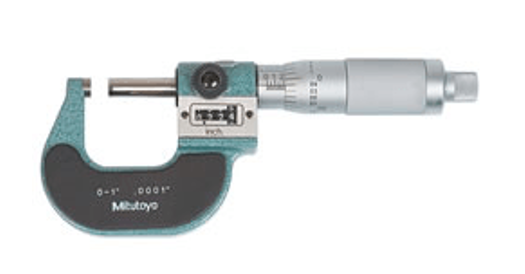
Mechanical micrometers are instruments for precision dimensional gaging consisting of a ground spindle and anvil mounted in a C-shaped steel frame. They are available in Vernier scale, digital and dial variations. Micrometers provide precise, quantitative measurements of a product's or component's attributes such as thickness, depth, height, length, I.D., O.D., roundness or bore.
Specialized micrometers are available for the measurement of threads, gear teeth and tube wall thickness. Noncontact laser micrometers are also available. Laser micrometers are especially effective in inline gaging applications of high speed materials.
Types of Micrometers
Common micrometer types include external, internal, bore, height, laser, micrometer head, and thread.
- External micrometers are capable of measuring an outer diameter (OD) or outside feature of a part or component.
- Internal micrometers are capable of measuring an inner diameter (ID) or inside feature or cavity of a part or component.
- Bore micrometers have the ability to measure the inside diameter of a hole, bore, or blind hole at shallow to very deep (~0.03m inches to several feet) depths into the bore.
- Height micrometers are tailored for height measurement.
- Laser micrometers use optical, laser, or video-based technology to measure dimensional features.
- Micrometer heads or jig borer micrometers consist only of the spindle and drum portion (no frame or anvil). They are built into microscopes, machine tools, medical equipment or other metrological systems to provide precision measurement or positioning. Jig borer micrometers and end measuring rods (fixed standard) are commonly used to set spacing and table locations.
- Thread micrometers are designed for measuring thread size, pitch, or other parameters.
Micrometers can be available in sets of several gages and accessories packaged into a kit usually in a case with adjusting tools. Tool kits sometimes contain alternate extensions and contact tips, holders, bases, or standards.
Specifications
Important parameters to consider when specifying micrometers include range and resolution. The range of the micrometer is the total range length or dimensional range that the gage can measure. The resolution is the best or minimum resolution for gages with digital displays. Measurement units for micrometers can be either English or metric with some being configured to measure both. The display can be non-graduated meaning that the micrometer has no display, dial or analog, digital display, column or bargraph display, remote display, or Vernier scale.
Features
Micrometers come with cylindrical anvils and spindles with flat carbide or hardened steel contacting faces. Specialized anvils or spindles are also available, these include ball anvil, blade or spade anvil, flange of disc (gear tooth), pin or reduced face, point anvil (thread gaging), or v anvil or 3-point. Mounting options for micrometers include:
- Handheld or portable
- Machine mounted
- Benchtop or floor
- Automatic or inline
Micrometers may be supplied with plastic, heat insulating handles or holders. The insulating handles help prevent measurement errors in the gage that could be caused by the heat from a human hand. Machine travel enabled micrometers are typically mounted on a machine or are built into a product including machine tools, microscopes, and other instruments requiring precision dimensional measurement or position control.
Standards
A-A-58075—Holder: Countersink, Adjustable Micrometer Stop
ASME B89.1.13—Micrometers
BS 1734—Specification for Micrometer Heads
Micrometer FAQs
What are the key differences between the various types of micrometers and their specific applications in engineering?
Here are the key differences between various types of micrometers and their specific applications in engineering:
Internal Micrometers
Purpose: Used for measuring the inner diameter (ID) or inside features or cavities of a part or component.
Application: Ideal for applications where precise internal measurements are required, such as in the manufacturing of pipes or cylinders.
Bore Micrometers
Purpose: Designed to measure the inside diameter of a hole, bore, or blind hole.
Application: Suitable for measuring at shallow to very deep depths, making them useful in industries like automotive and aerospace where precise bore measurements are critical.
Height Micrometers
Purpose: Tailored specifically for height measurement.
Application: Used in applications where vertical measurements are necessary, such as in quality control processes in manufacturing.
Laser Micrometers
Purpose: Utilize optical, laser, or video-based technology for measuring dimensional features.
Application: Commonly used in production environments for non-contact measurement, ensuring high accuracy during the gaging of moving products like wires or bars.
Micrometer Heads or Jig Borer Micrometers
Purpose: Consist only of the spindle and drum portion, without a frame or anvil.
Application: Integrated into microscopes, machine tools, or medical equipment for precision measurement or positioning. They are often used to set spacing and table locations.
Automatic or Inline Laser Micrometers
Purpose: Measure parts automatically without operator intervention.
Application: Used in production lines for continuous measurement of moving products, maintaining high accuracy levels.
Benchtop or Floor Mounted Laser Micrometers:
Purpose: Parts are manually loaded and measured.
Application: Suitable for stationary or benchtop applications where manual measurement is feasible.
Handheld Laser Micrometers
Purpose: Operated while being held in the hand.
Application: Useful for portable measurement tasks where flexibility and mobility are required.
Machine Mounted Micrometers
Purpose: Mounted within or on a machine tool for tool setup or travel measurement.
Application: Commonly used in machining processes to ensure precise tool positioning and movement.
These micrometers are selected based on the specific measurement requirements and the environment in which they will be used, ensuring precision and efficiency in engineering applications.
How do laser micrometers compare to internal micrometers in terms of accuracy?
When comparing laser micrometers to internal micrometers in terms of accuracy, there are several factors to consider:
Measurement Technology
Laser Micrometers: These utilize optical, laser, or video-based technology to measure dimensional features. They are particularly effective in non-contact measurement scenarios, which can be advantageous for maintaining accuracy during the measurement of moving products such as wires or bars.
Internal Micrometers: These are specifically designed for measuring the inner diameter or inside features of a part or component. They are contact-based measurement tools, which can provide high precision for internal dimensions.
Application Environment
Laser Micrometers: They are versatile and can be used in various configurations such as automatic or inline, benchtop, handheld, or machine-mounted. This adaptability allows them to maintain high accuracy in different production environments, especially for continuous measurement tasks.
Internal Micrometers: These are more specialized for internal measurements and are typically used in environments where precise internal dimension measurement is critical, such as in the manufacturing of pipes or cylinders.
Accuracy Levels
While both types of micrometers are designed to provide high accuracy, the specific accuracy levels can vary based on the design and application. Laser micrometers are known for maintaining high accuracy in dynamic and non-contact measurement scenarios, whereas internal micrometers excel in providing precise measurements for internal features.
What are the limitations of using internal micrometers?
When considering the limitations of using internal micrometers, it's important to note that while they are highly specialized tools for measuring internal dimensions, they do have certain constraints:
Limited to Internal Measurements
Internal micrometers are specifically designed for measuring inner diameters or inside features of components. This specialization means they are not suitable for external measurements or other types of dimensional assessments.
Accessibility Challenges
Measuring certain internal features can be challenging if the micrometer cannot easily access the area due to design constraints or obstructions within the component.
Contact-Based Measurement
As internal micrometers rely on contact-based measurement, they may not be suitable for delicate or soft materials where contact could cause deformation or damage.
Calibration and Maintenance
Like all precision instruments, internal micrometers require regular calibration and maintenance to ensure accuracy, which can be resource-intensive.
How do micrometers compare to calipers in terms of precision and application?
When comparing micrometers to calipers in terms of precision and application, there are several key differences to consider:
Resolution
Micrometers: Typically offer higher resolution, reading to 0.0005 inches or better, which allows for more precise measurements.
Calipers: Generally have a lower resolution, reading to 0.001 inches, which makes them less precise compared to micrometers.
Measurement Accuracy
Micrometers: Known for their high accuracy, especially in applications where precise measurements are critical. They are not subject to Abbe offset errors because the measurement barrel is in line with the measurement axis.
Calipers: While versatile, they can be subject to Abbe offset errors due to the measurement scale being offset from the measurement axis.
Application
Micrometers: Typically used for specific measurement tasks, such as measuring the thickness or diameter of small objects. They are available in various types, including internal, external, and depth micrometers, each designed for specific applications.
Calipers: More versatile and can be used for a wider range of measurements, including internal, external, and depth measurements. They are often used for quick checks and less critical measurements.
Ease of Use
Micrometers: Require more skill and time to use due to their precision and the need for proper alignment and calibration.
Calipers: Easier and quicker to use, making them suitable for general-purpose measurements and situations where speed is more important than extreme precision.
Cost and Practicality
Micrometers: Can be more costly and may require multiple versions for different measurement tasks.
Calipers: Generally more cost-effective and practical for a variety of measurement tasks, especially in environments where multiple types of measurements are needed.
These differences highlight that while micrometers provide higher precision, calipers offer greater versatility and ease of use, making them suitable for different types of applications depending on the specific measurement requirements.
What are the common types of calipers and their uses?
When discussing the common types of calipers and their uses, it's important to note the versatility and practicality of calipers in various measurement tasks. Here are some common types of calipers and their typical applications:
Vernier Calipers
Description: These calipers use a vernier scale for precise measurements. They consist of a main scale and a sliding vernier scale.
Uses: Suitable for measuring internal and external dimensions, as well as depths. They are often used in mechanical engineering and metalworking for tasks requiring moderate precision.
Dial Calipers
Description: Feature a dial indicator for reading measurements, which can be easier to read than a vernier scale.
Uses: Commonly used in situations where quick and easy reading is necessary. They are versatile for measuring internal, external, and depth dimensions.
Digital Calipers
Description: Equipped with a digital display for easy reading of measurements. They can switch between metric and imperial units.
Uses: Ideal for applications requiring quick and accurate measurements. They are widely used in various industries for both precision and ease of use.
Inside Calipers
Description: Designed specifically for measuring the internal dimensions of an object.
Uses: Used to measure the internal diameter of pipes, holes, or other internal features.
Outside Calipers
Description: Used for measuring the external dimensions of an object.
Uses: Suitable for measuring the thickness or diameter of objects.
Spring Calipers
Description: Feature a spring mechanism for tension, allowing for consistent measurement pressure.
Uses: Often used in woodworking and metalworking for transferring measurements.
Applications
General Purpose Measurements: Calipers are often used for quick checks and less critical measurements due to their ease of use and versatility.
Precision Engineering: While calipers offer less precision than micrometers, they are still valuable in engineering applications where moderate precision is sufficient.
Manufacturing and Quality Control: Calipers are used in manufacturing processes to ensure components meet specified dimensions.
These types of calipers provide a range of options for different measurement needs, balancing precision, ease of use, and versatility.
Micrometer Media Gallery
References
GlobalSpec—The Caliper: A Simple, Essential Tool Since Roman Times
GlobalSpec—Optical Micrometers and Laser Micrometers Information
Image credit:
ValueTronics International, Inc.
- Automatic / Inline
- Benchtop / Floor
- Bore Micrometer
- Dial / Analog / Direct Reading Scale
- Digital Display
- English
- External Micrometer
- Handheld / Portable
- Height Micrometer
- Internal Micrometer
- Machine Mounted
- Mechanical
- Metric
- Micrometer Head
- Micrometer Set
- Non-contact
- Optical - LED
- Optical - Laser
- Optical - Video / Imaging
- Standard Type - Flat Anvil
- Thread Micrometer
- bench micrometer
- how to calibrate a micrometer
- pin micrometer
- etalon micrometer
- automatic micrometer
- capacitive micrometer
- functions of micrometer
- motorized micrometer
- optical micrometer
- stepper motor micrometers
- bar micrometer
- ball end micrometers
- digital benchtop micrometers
- digital groove micrometers
- etalon pressure micrometers
- gear tooth micrometers
- ID pitch micrometers
- ID thread micrometers
- o-ring micrometers
- over bar micrometers
- precision stage micrometers
- snap gauge micrometers
- t-bar micrometers
- tube wall thickness micrometers
- ultra precision micrometers