
Zener Diodes Information
Last revised: December 12, 2024
Reviewed by: Scott Orlosky, consulting engineer
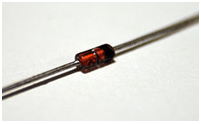
Zener diodes are PN junction devices that are designed to operate in the reverse-breakdown region. The breakdown voltage (Vz) of Zener diodes is set by carefully controlling the doping level during manufacture. This breakdown phenomenon is referred to as the Zener voltage or the Zener effect.
Function
The Zener effect functions as follows. When reverse voltage is applied to the PN junction of a diode, there is a rapid avalanche breakdown. This causes the current to reverse direction. The change in current direction accelerates valence electrons within the applied electric field, enough to free them. These free valence electrons collide with and free other electrons, building the avalanche.
While this process is taking place, the current changes rapidly. Changes in current are based on changes in voltage, and even a tiny voltage change can have a massive effect on the current. In practical application, the avalanche breakdown depends upon the applied electric field.
Changing the thickness of the layer to which the voltage is applied forms Zener diodes. Typical Zener diodes break down at voltages from about 4 volts to several hundred volts.
Uses
Functionally, Zener diodes are used as regulators, limiters and to control output switching.
Regulators
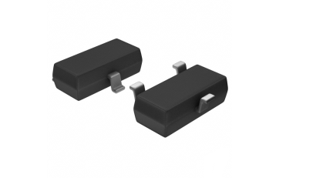
When used as regulators, the constant reverse voltage of Zener diodes allows for the regulation of output voltage against both variations in the input voltage from an unregulated power supply and from variations in the load resistance. The current traveling through Zener diodes changes to keep the voltage within the threshold of Zener action and the maximum power it can dissipate. Zener regulators tend to function most efficiently when constant voltage is applied, especially when used in conjunction with regulated power supplies, and for limiter applications.
Limiters
Zener limiters are constructed with two opposing Zener diodes. Each individual diode can limit one side of a sinusoidal waveform to Zener voltage while keeping the other side near zero. When the two opposing Zener diodes are paired, the waveform is limited to Zener voltage on both polarities.
Controlling Output Switching
Zener diodes are also used to control output switching. In this application, Zener diodes switch the output between voltages. This is determined by the changes in input voltage through the diode. The output circuit amounts to a Zener regulator that switches from one Zener voltage to the other on transition through the Zener diode.
Standards
JEDEC JESD 211 — Zener and voltage regulator diode rating verification and characterization testing.
Zener Diodes FAQs
How do Zener diodes function in electronic circuits?
Zener diodes function in electronic circuits primarily as voltage regulators and reference devices. Here is a detailed explanation of their operation:
Zener diodes are designed to operate in the reverse-bias condition. Unlike regular diodes, which are damaged if the reverse voltage exceeds their peak inverse voltage (PIV), Zener diodes are doped to handle this condition safely. They maintain a constant voltage, known as the Zener voltage, across them when reverse-biased.
In their breakdown region, Zener diodes produce a nearly constant voltage, making them ideal for voltage regulation. They are used to stabilize the output voltage against variations in input voltage and load resistance. This is achieved by allowing the current through the diode to change while maintaining the voltage within the Zener threshold.
Voltage Reference: Zener diodes provide a simple means of voltage reference due to their ability to maintain a constant voltage.
Limiters: They can be used as limiters by pairing two opposing Zener diodes to limit both polarities of a waveform to the Zener voltage.
Switching Control: Zener diodes can control output switching by transitioning between different Zener voltages based on input voltage changes
Zener diodes are characterized by their Zener voltage, which typically ranges from 3.3 volts to 75 volts, though other values are available. They also have specified tolerances and power-handling capabilities.
Zener diodes are used in transient suppression applications due to their effective clamping ability, which maintains a constant voltage during surge discharge.
What are the differences between Zener diodes and regular diodes?
Regular Diodes: These are typically used in the forward-bias condition, where they allow current to pass through once the forward voltage (usually around 0.7 volts for silicon diodes) is exceeded. They are not designed to handle reverse voltage beyond their peak inverse voltage (PIV) without damage.
Zener Diodes: These are specifically designed to operate in the reverse-bias condition. They can safely conduct in reverse once the reverse voltage reaches the Zener voltage, maintaining a constant voltage across them.
Regular Diodes: Do not provide voltage regulation. They are mainly used for rectification, allowing current to flow in one direction.
Zener Diodes: Used for voltage regulation. They maintain a nearly constant voltage (Zener voltage) across them in the breakdown region, making them ideal for stabilizing voltage in circuits.
Regular Diodes: Enter breakdown when the reverse voltage exceeds their PIV, which can lead to diode failure.
Zener Diodes: Intentionally operate in the breakdown region to provide a stable reference voltage. The breakdown voltage is the Zener voltage, and they are designed to handle this condition safely.
Regular Diodes: Commonly used in rectification, signal demodulation, and other applications where unidirectional current flow is needed.
Zener Diodes: Used in voltage regulation, voltage reference, transient suppression, and waveform limiting applications.
How are Zener diodes used in voltage regulation circuits?
Zener diodes are widely used in voltage regulation circuits due to their ability to maintain a constant voltage across them when reverse-biased. Here's how they function in such circuits:
In a voltage regulation circuit, the Zener diode is connected in parallel with the load across which the voltage needs to be regulated. The Zener diode maintains a nearly constant voltage (Zener voltage) across the load by allowing the current through the diode to change in response to variations in the input voltage or load resistance. This ensures that the output voltage remains stable.
The current through the Zener diode changes to keep the voltage within the threshold of Zener action and the maximum power it can dissipate. This dynamic adjustment helps in maintaining the desired output voltage despite fluctuations in the input voltage or load conditions.
Zener diodes are used in various applications requiring voltage regulation, such as power supplies, where they help in providing a stable reference voltage. They are also used in circuits where voltage clamping is necessary to protect sensitive components from voltage spikes.
How can Zener breakdown be used?
In the breakdown region, the Zener diode maintains a constant voltage, making it ideal for voltage regulation applications. This characteristic is utilized to stabilize the output voltage in circuits, even when there are variations in input voltage or load conditions.
While Zener breakdown is predominant at lower voltages (typically below 5.6 volts), at higher voltages, the breakdown mechanism is often a combination of Zener and avalanche breakdown. Avalanche breakdown involves carriers gaining enough energy from the electric field to create additional electron-hole pairs, leading to a chain reaction and increased current.
Zener diodes are used in various applications such as voltage reference, voltage regulation, and transient suppression. Their ability to maintain a constant voltage during breakdown makes them valuable in protecting circuits from voltage spikes and ensuring stable operation.
What are the differences between Zener and avalanche breakdown?
Zener breakdown occurs in heavily doped diodes at relatively low reverse voltages. It is characterized by a strong electric field across the diode's junction, which causes electrons to tunnel through the energy barrier from the valence band to the conduction band, leading to a significant increase in current while maintaining a nearly constant voltage across the diode.
Zener breakdown is predominant at lower voltages, typically below 5.6 volts.
The breakdown voltage is controlled by the doping level of the semiconductor material. Heavily doped diodes have a thinner depletion layer, resulting in a lower Zener voltage.
Avalanche breakdown occurs at higher reverse voltages and involves a different mechanism. In this case, the carriers (electrons and holes) gain enough kinetic energy from the electric field to create additional electron-hole pairs through impact ionization. This leads to a chain reaction and a rapid increase in current.
Avalanche breakdown is more significant at higher voltages, typically above 5.6 volts.
Lightly doped diodes have a thicker depletion layer, which is conducive to avalanche breakdown at higher voltages.
Zener Diodes: Are primarily used for voltage regulation and reference due to their ability to maintain a constant voltage in the breakdown region.
Avalanche Diodes: Are used in applications requiring high-voltage protection and transient suppression due to their ability to handle higher breakdown voltages.
How does the doping process affect the characteristics of semiconductor devices?
The doping level in a semiconductor affects the electric field across the junction. In Zener diodes, the strength of this electric field determines the Zener breakdown mechanism, which occurs when the diode is reverse-biased and the reverse voltage reaches the Zener voltage. The doping concentration determines the thickness of the depletion layer, which in turn influences the breakdown voltage.
By adjusting the doping levels, manufacturers can control the breakdown voltage of the diode. Heavily doped diodes have a thinner depletion layer, resulting in a lower Zener voltage, while lightly doped diodes have a thicker depletion layer, leading to a higher Zener voltage.
These aspects highlight the critical role of the doping process in determining the electrical characteristics and performance of semiconductor devices, allowing for the customization of devices like Zener diodes for specific applications.
Zener Diodes Media Gallery
References
GlobalSpec—Basic Electricity and Electronics for Control: Fundamentals and Applications, 3rd Edition
GlobalSpec—Electronics I Laboratory Manual
GlobalSpec—Current Sources & Voltage References
Image Credit:
Wikipedia | Digi-Key Corporation
- zener diode
- winch wiring diagram
- high voltage zener diodes
- high current zener diodes
- 1 volt zener diodes
- 1.2v zener diodes
- 1.5v zener diodes
- 1.8v zener diodes
- 15-18v zener diodes
- 15V 10w zener diodes
- 15V 2w zener diodes
- 15V 3w zener diodes
- 15V zener diodes
- 1v zener diodes
- 2.5v zener diodes
- 5v6 zener diodes
- 6 volt zener diodes
- high frequency zener diodes
- high power zener diodes
- low capacitance zener diodes
- low current zener diodes
- low leakage zener diodes