
Multiconductor Cables Information
Multiconductor cables contain two or more conductors and are used in many applications including communications, sound reinforcement and machine control. Each conductor consists of a single wire or a combination of wires. 
Type
Multiconductor cables are manufactured as both bulk cable and cable assemblies.
-
Bulk cables are sold by the foot and/or on a reel. They typically do not include end connectors.
-
Cable assemblies are collections of wires or cables banded into a single unit. They are of fixed length and feature connectors on at least one end.
Conductors
A cable conductor consists of a wire or combination of wires that are not insulated from each other, and facilitate the passage of electric current through the cable. Conductor-related specifications include material, size, and number of conductors.
- Conductor material includes various conductive metals. Copper is the most widely used material, and features excellent corrosion resistance and high thermal conductivity, but relatively low strength-to-weight ratio. Aluminum is less dense than copper, and is often used as a power conductor. Cable conductors may also be made of steel and clad with an aluminum or copper shell.
- Conductor size is measured in American Wire Gauge (AWG) in the United States. The higher the gauge number, the smaller the diameter and thinner the wire. Thicker wires have less resistance and are able to carry more current. Outside of the U.S., conductors are measured in mm2.
- Number of conductors is usually determined by the cable's application or intended use.
Jacket and Insulation Material
Suppliers manufacture cable using a variety of jacket and insulation material in order to reduce the leakage of current from the conductor. The cable's application is an important consideration when selecting insulation material.
- Ethylene Propylene Diene Elastomer (EPDM) provides excellent flexibility over a wide temperature range.
- Neoprene is a synthetic rubber well-suited to chemical applications. It is resistant to oil, flames, and chemicals.
- Silicon rubber provides superior flexibility but lacks toughness and fluid resistance.
- Thermoplastic is an excellent insulating material. Polyethylene (PE), polyproplyene, polyvinyl chloride (PVC), Teflon®, and Tefzel® are types of thermoplastic material. While each material has its own unique advantages and disadvantages, most are highly flexible and provide resistance to moisture or chemicals.
- Mica tape is specific to insulation material, and features a very high temperature resistance.
Shielding
Multiconductor cables may feature a type of electromagnetic shielding material, which is wrapped around the cable underneath the outer jacket. Shielding serves to prevent electrical noise from affecting the transmitted signal, and to reduce electromagnetic radiation emission from the cable itself. Shielding is typically comprised of metal braiding, metal tape or foil braiding. A shielded cable may also feature a special grounding wire known as a drain wire.
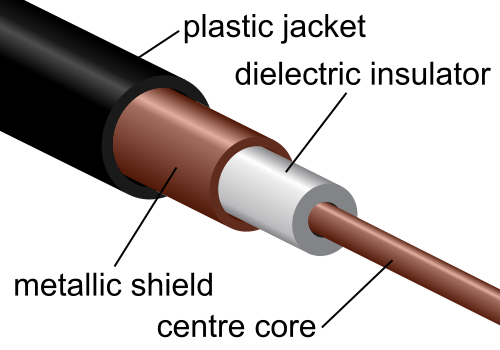
Cutaway image of a shielded cable.
Standards
MIL-HDBK-176 -- Guidance for Flexible Flat Multiconductor Cable
MIL-C-27072/1 -- Cable, Special Purpose Electrical, Multiconductor
MIL-DTL-27072/16 -- Cable, Special Purpose, Electrical, Multiconductor (3 Conductors)
References
Alpha Wire - Understanding shielded cable (pdf)
Cabling Plus - Multi-Conductor Cable
Image credit:
New England Wire Technologies | Point Grey Research Inc.
- Alabama
- Arkansas
- Arizona
- California
- Colorado
- Connecticut
- Delaware
- Florida
- Georgia
- Iowa
- Illinois
- Indiana
- Kentucky
- Louisiana
- Massachusetts
- Maryland
- Michigan
- Minnesota
- Missouri
- North Carolina
- New Hampshire
- New Jersey
- New Mexico
- New York
- Ohio
- Oklahoma
- Oregon
- Pennsylvania
- Rhode Island
- South Carolina
- Tennessee
- Texas
- Virginia
- Vermont
- Washington
- Wisconsin
- AWG 2/0, 3/0, 4/0 or Larger
- Aluminum Clad Steel
- Aluminum and Aluminum Alloys
- Braid
- Bulk Cable
- CE Marking
- CSA Mark
- Cable Assembly
- Copper Clad Steel
- Copper and Copper Alloys
- Drain Wire / Copper Wire
- Ethylene Propylene Diene Elastomer (EPDM)
- Ethylene Propylene Diene Elastomer (EPDM)
- Foil / Copper Tape
- Foil Braid
- IEC
- ISO
- MIL-SPEC
- Mica Tape
- Neoprene
- Neoprene
- No Shielding
- Polyethylene (PE)
- Polyethylene (PE)
- Polypropylene
- Polyvinyl Chloride (PVC)
- Polyvinyl Chloride (PVC)
- RoHS
- Silicon Rubber
- Silicon Rubber
- Teflon
- Teflon®
- Tefzel
- Tefzel®
- UL Recognized Component Mark (US and Canadian)
- VDE