
Electrical Power Wires Information

Electrical power wires are solid or stranded conductors surrounded by insulation, shielding, and a protective jacket.
The Engineering360 SpecSearch database allows industrial buyers to select these types of electrical power wires.
Instrumentation and control cable assemblies are designed specifically for instrumentation and control applications, including network connections.
Power cordage cables are used mainly for low-voltage, commercial, or residential applications. They are used to make power cords, but do not include end connectors.
Multiconductor cables contain two or more conductors, each of which consists of a single wire or a combination of wires. To prevent electromagnetic interference (EMI), cable shielding is placed around the insulated conductor(s).
Single conductor wire contains only one wire or conductor. Like multiconductor cables, cable shielding is used.
Transmission and distribution wires are solid or stranded conductors that are surrounded by insulation, shielding, and a protective jacket. Generally, these cables are used in industrial applications and for power stations.
Conductors
A conductor consists of a wire or combination of wires that are not insulated from each other, and facilitate the passage of electric current through the cable. Conductor-related specifications include material, size, and number of conductors.
Conductor material includes various conductive metals. Copper is the most widely used material, and features excellent corrosion resistance and high thermal conductivity, but relatively low strength-to-weight ratio. Aluminum is less dense than copper, and is often used as a power conductor. Cable conductors may also be made of steel and clad with an aluminum or copper shell.
Conductor size is measured in American Wire Gauge (AWG) in the United States. The higher the gauge number, the smaller the diameter and thinner the wire. Thicker wires have less resistance and are able to carry more current. Outside of the U.S., conductors are measured in mm2.
Number of conductors is usually determined by the cable's application or intended use.
Jacket and Insulation Material
Suppliers manufacture cable using a variety of jacket and insulation material in order to reduce the leakage of current from the conductor. The cable's application is an important consideration when selecting insulation material.
-
Ethylene Propylene Diene Elastomer (EPDM) provides excellent flexibility over a wide temperature range.
-
Neoprene is a synthetic rubber well-suited to chemical applications. It is resistant to oil, flames, and chemicals.
-
Silicon rubber provides superior flexibility but lacks toughness and fluid resistance.
-
Thermoplastic is an excellent insulating material. Polyethylene (PE), polyproplyene, polyvinyl chloride (PVC), Teflon®, and Tefzel® are types of thermoplastic material. While each material has its own unique advantages and disadvantages, most are highly flexible and provide resistance to moisture or chemicals.
-
Mica tape is specific to insulation material, and features a very high temperature resistance.
Rated Voltage
Rated voltage is an important specification to consider when selecting electrical power wire. A cable's rated voltage affects other aspects of its design, such as the type and thickness of its insulation. Most cables designed for high voltage applications use thicker thermoplastic insulation, which has generally replaced the older oil and paper insulation used before 1960.
When discussing electric power, applications using < 1 kV are considered low voltage, 1-36 kV are medium voltage, and > 36 kV are high voltage.
Shielding
Electrical power wire may feature a type of electromagnetic shielding material, which is wrapped around the cable underneath the outer jacket. Shielding serves to prevent electrical noise from affecting the transmitted signal, and to reduce electromagnetic radiation emission from the cable itself. Shielding is typically comprised of metal braiding, metal tape or foil braiding. A shielded cable may also feature a special grounding wire known as a drain wire.
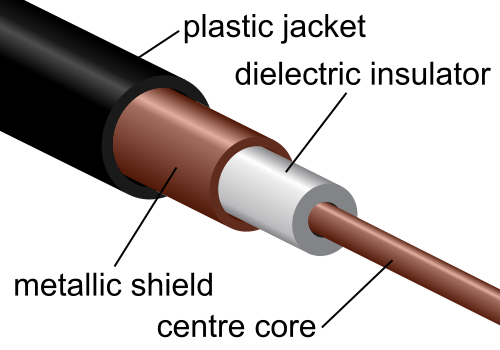
Cutaway image of a shielded cable. Image credit: Tkgd2007
References
Alpha Wire - Understanding shielded cable
Gore - Impact of materials on microwave cable performance
Gore - Selecting the right cable system for your environment
Image credit:
Multi-Contact
- Alabama
- Arkansas
- Arizona
- California
- Colorado
- Connecticut
- Florida
- Georgia
- Iowa
- Illinois
- Indiana
- Kentucky
- Louisiana
- Massachusetts
- Maryland
- Maine
- Michigan
- Minnesota
- Missouri
- North Carolina
- New Hampshire
- New Jersey
- New Mexico
- Nevada
- New York
- Ohio
- Oklahoma
- Oregon
- Pennsylvania
- Rhode Island
- South Carolina
- Tennessee
- Texas
- Virginia
- Vermont
- Washington
- Wisconsin
- West Virginia
- AWG 2/0, 3/0, 4/0 or Larger
- Aluminum Clad Steel
- Aluminum and Aluminum Alloys
- Braid
- CE Marking
- CSA Mark
- Copper and Copper Alloys
- Cordage
- Drain Wire / Copper Wire
- Ethylene Propylene Diene Elastomer (EPDM)
- Foil / Copper Tape
- Foil Braid
- IEC
- ISO
- Industrial / Instrumentation and Control
- MIL-SPEC
- Mica Tape
- Multiconductor Cable
- Neoprene
- Neoprene
- Polyethylene (PE)
- Polyethylene (PE)
- Polypropylene
- Polyvinyl Chloride (PVC)
- Polyvinyl Chloride (PVC)
- RoHS
- Silicon Rubber
- Silicon Rubber
- Single Conductor Wire
- Teflon
- Tefzel
- Transmission / Distribution Wire
- UL Recognized Component Mark (US and Canadian)
- VDE
- 600 MCM cable
- silicone insulated wire
- biw cable system
- plenum rated power cables
- #2 aluminum direct burial wire
- 100 amp power cables
- 132kv xlpe power cables
- 22 AWG silicone insulated wire
- 220V power cables
- 400 hz power cables
- 600V shielded power cables
- 8 AWG power cables
- barrel power cables
- braided electrical wire
- c13 c14 power cables
- c19 to c13 power cables
- c19 to c14 power cables
- ceramic insulated wire
- HDPE insulated wire
- IEC c19 power cables
- laser beacon 6025 power cables
- marine electrical cables
- polarized power cables
- polyimide insulated wire
- rubber insulated wire
- ship to shore power cables
- thin insulated wire