
Rotating Air Cylinders
Description
Rotating air cylinders are pneumatic devices designed to convert compressed air energy into rotary motion. These actuators typically provide angular rotation up to 360 degrees, allowing for precise control of rotational movements. They are encased in a frame that supports the rotary mechanism, ensuring stability and efficiency during operation.
Working Principle
Rotating air cylinders operate by using air pressure to induce rotary motion. The air pressure acts on a vane or a rack and pinion mechanism within the actuator, causing it to rotate. This rotary motion is achieved by converting the linear motion of the piston into rotational movement. The simplicity of their design makes them useful in applications where precise and controlled rotation is required. Their ability to provide continuous rotation makes them versatile for various industrial tasks.
Applications
Rotating air cylinders are used in a variety of applications that require controlled rotational movement. Specific examples include turning components over in a drilling jig, providing wrist action on pick-and-place devices, and operating process valves. They are also employed in material handling systems and assembly processes where precise rotational positioning is essential.
Advantages over other Air Cylinders
Rotating air cylinders offer several advantages over traditional linear air cylinders. They provide continuous rotation, which is not possible with standard linear cylinders. This capability makes them ideal for applications requiring full 360-degree rotation. Additionally, their design allows for compact and efficient integration into systems where space is limited, providing a high power-to-weight ratio and ease of control.
Limitations
One of the limitations of rotating air cylinders is their noise level, which can be higher compared to other types of actuators. Additionally, the overall system efficiency can be lower, with some designs achieving only about 20% efficiency. This can be a consideration in applications where energy efficiency is a priority.
Considerations
When selecting rotating air cylinders, several factors should be considered. Initial costs can vary depending on the complexity and design of the actuator. Operating expenses may include the cost of compressed air and maintenance. Durability is generally high, but regular maintenance is required to ensure optimal performance and longevity. Accuracy in positioning can be affected by factors such as air pressure stability and mechanical wear, so it is important to consider the specific requirements of the application. Replacement and maintenance costs should also be factored into the overall cost of ownership.

from Compact Automation
Multi Act ’s integrated multi position devices include multi position cylinders and multi position actuators, which feature an output shaft that produces both linear and rotary motions and may be operated independently and simultaneously. These devices offer many advantages over single... [See More]
- Cylinder Style: Miniture; Rectangular; Rotating
- Rated Load/Force: 100
- Stroke: 1 to 4
- Operating Pressure: 35 to 200
from PHD, Inc.
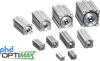
The PHD Optimax ® Series OCQ Pneumatic Compact Cylinder features a compact design for applications where cylinder length is critical. The Series OCQ features drop-in metric mounting to match the global standard, and is available in 10 bore sizes in incremental stroke lengths to fit a variety of... [See More]
- Cylinder Style: Rotating
- Cylinder Configuration: Simple
- Operating Temperature: -20 to 180
- Body Material: Steel
from PHD, Inc.
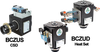
Series BCZU Universal Nozzle Cylinders are direct replacements for Sidel ® Universal Machines. These cylinders mount into the same space and bolt patterns, provide significantly longer service life, and reduce maintenance and downtime in stretch blow molding applications. Units are field... [See More]
- Cylinder Style: Rotating
- Cylinder Configuration: Simple
- Operating Temperature: -20 to 180
- Body Material: Steel