
Integral Sensor Air Cylinders
Description
Integral Sensor Air Cylinders are pneumatic devices that incorporate sensors directly within the cylinder structure. These sensors provide real-time feedback on the position and velocity of the piston within the cylinder, allowing for precise control and monitoring of the cylinder's operation.
Working Principle
Integral Sensor Air Cylinders operate by using embedded sensors, such as magnetostrictive linear position sensors, to continuously monitor the position of the piston. These sensors provide highly accurate, continuous, and absolute output, which is crucial for applications requiring precise control. The sensors are non-contacting, which enhances their durability and reliability by minimizing wear and tear. The integration of sensors within the cylinder allows for simultaneous position and velocity outputs, making them particularly useful for servo-type feedback control systems .
Applications
Integral Sensor Air Cylinders are used in a variety of applications where precise control of pneumatic systems is required. Specific examples include automated manufacturing processes where exact positioning is critical, robotics where precise movement control is necessary, and in distributed control architectures where real-time feedback is essential for system integration .
Advantages over other Air Cylinders
One of the primary advantages of Integral Sensor Air Cylinders over traditional air cylinders is their ability to provide superior position feedback due to the highly accurate and continuous output of the embedded sensors. This feature allows for faster and easier setup compared to mechanical limit switches. Additionally, these cylinders offer high shock and vibration tolerance and superior EMI and noise immunity, ensuring trouble-free operation in demanding environments .
Limitations
While Integral Sensor Air Cylinders offer many advantages, they may have limitations such as higher initial costs due to the integration of advanced sensor technology. Additionally, the complexity of the embedded systems may require specialized knowledge for maintenance and troubleshooting.
Considerations
When considering Integral Sensor Air Cylinders, it is important to evaluate the initial costs, which may be higher than standard air cylinders due to the integrated sensors. However, the operating expenses may be lower in the long term due to reduced maintenance needs and increased accuracy. Durability is enhanced by the non-contacting nature of the sensors, which minimizes wear. Accuracy is a significant advantage, with sensors providing precise feedback even under adverse conditions. Replacement and maintenance costs should also be considered, as specialized components may require specific expertise for servicing .

from Aries Engineering Co., Inc.
The IntelliCyl ® is the successful combination of HyperCyl ’s hydra-pnuematic cylinder systems and state of the art electronic technology. IntelliCyl ® was designed for applications where continuous monitoring of materials and processes is critical to the successful assembly of... [See More]
- Features: Home / Limit / Position Switches; Linear Position Feedback; Integral Sensor
- Rated Load/Force: 2000 to 50000
- Stroke: 2 to 8
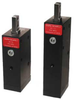
from R&I Manufacturing Co.
DURA-SCAPE CC Series of Economy Non-Rotating Air Cylinders are designed as multi purpose units. The CC series is designed for applications where all the features of our SC series are not required, while still offering the time-tested quality construction and durability you ’ve come to expect. [See More]
- Features: Adjustable Stroke; Integral Sensor; Non-Rotating
- Operating Pressure: 40 to 100
- Stroke: 0.7500 to 1.25
- Bore Size: 0.6250