
Thermocouple Sensor Transmitters
Last Updated: April 1, 2025
Description
Thermocouple sensor transmitters are devices that convert the low-level voltage signals generated by thermocouples into higher-level signals suitable for transmission and processing. These transmitters are designed to accept inputs from thermocouples and condition these signals for further use in monitoring and control systems.
Working Principle
Thermocouple sensor transmitters operate based on the Seebeck Effect, where a voltage is produced when two different metals are joined at their ends and exposed to a temperature gradient. This voltage correlates with the temperature difference between the two ends of the thermocouple. The transmitter amplifies, isolates, and converts this low-level voltage signal into a more robust signal, typically a 4-20 mA current loop, which can be easily transmitted over long distances for monitoring or control purposes. This makes them particularly useful in industrial applications where remote temperature sensing is required.
Applications
Thermocouple sensor transmitters are widely used in various industrial applications. Specific examples include monitoring temperature in gas turbines, heating systems, electric furnaces, and diesel engines. They are also employed in manufacturing processes, petrochemical industries, HVAC systems, and scientific research, where precise temperature measurements are critical.
Advantages over other Sensor Transmitters
Thermocouple sensor transmitters offer several advantages over other types of sensor transmitters. They are highly accurate and reliable over a wide range of temperatures, making them suitable for diverse applications. Their simple design, consisting of just two wires, allows for easy installation and maintenance. Additionally, they are cost-effective and durable, capable of withstanding mechanical stress and vibration, which is beneficial in industrial and automotive environments.
Limitations
Despite their advantages, thermocouple sensor transmitters have some limitations. They can experience errors over extended periods due to material corrosion, which affects the thermoelectric voltage. Additionally, they require two temperature measurements to function, which can complicate the setup. The accuracy of thermocouples can also be affected by their exposure to harsh environments.
Considerations
When considering thermocouple sensor transmitters, it is important to evaluate initial costs, operating expenses, and maintenance requirements. They are generally more affordable than other temperature sensors, which is advantageous for budget-conscious applications. However, their durability and resistance to harsh conditions can lead to lower maintenance and replacement costs over time. Accuracy is a critical factor, and potential users should ensure that the thermocouples are compatible with their existing systems and are suitable for the specific temperature ranges and environmental conditions of their applications.

from Dataforth Corporation
Each DSCP20 2-wire transmitter is designed for measuring temperature using thermocouples or RTDs. The input type, measurement range, and other features are software configurable. A PC, the DSCX-887 and DSCX-416 interface cables, and the DSCX-895 configuration software are required to configure the... [See More]
- Inputs: Thermocouple Input; RTD Input
- Analog Channels: 1
- Outputs: Analog Current Output
- Differential Channels: Yes
from Laurel Electronics LLC
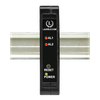
Features. Factory calibrated for thermocouple types J, K, T, E, N, R, S. Accuracy ±0.01% of full span ± conformity error. Entire range of each thermocouple in one scale. User selectable input span from entire thermocouple range down to 15.0 °. Selectable 1 ° or 0. °1,... [See More]
- Inputs: Thermocouple Input
- Form Factor: DIN Rail
- Outputs: Analog Current Output; Analog Voltage Output
- Analog Input: 100 pA
from Knick Interface LLC
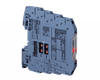
Standard transmitters for temperature measurement in a 6 mm housing using resistance thermometers or thermocouples. Flexible use. with common temperature sensors: Pt100, Pt1000, Ni100, type J and K thermocouples. Intuitive configuration. easy, without tools, using 4 rotary and 8 DIP switches. [See More]
- Inputs: Thermocouple Input; RTD Input; Resistance thermometers , Resistors , Shunt voltages up to +/-1000 mV , Thermocouples
- Form Factor: DIN Rail
- Outputs: 0 ... (±)5 V , 0 ... 10 V , 0 ... 20 mA , 4 ... 20 mA; Analog Current Output; Analog Voltage Output
- Analog Input: Resistance thermometers , Resistors , Shunt voltages up to +/-1000 mV , Thermocouples
from Knick Interface LLC
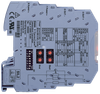
Universal transmitters for temperature, strain gauges and potentiometers - in a 6-mm housing with infrared interface and SIL approval. Universal usability from simple to challenging measurement tasks with all known temperature sensors, strain gauges, potentiometers, and similar sensors. Convenient... [See More]
- Inputs: Thermocouple Input; RTD Input; Bridge Input; Potentiometers , Resistance thermometers , Resistors , Shunt voltages up to +/-1000 mV , Strain gauges , Thermocouples
- Form Factor: DIN Rail
- Outputs: 0 ... (±)5 V , 0 ... 10 V , 0 ... 20 mA , 4 ... 20 mA; Analog Current Output; Analog Voltage Output
- Analog Input: Potentiometers , Resistance thermometers , Resistors , Shunt voltages up to +/-1000 mV , Strain gauges , Thermocouples
from Knick Interface LLC
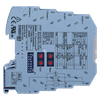
The universal transmitters for temperature measurement with resistance thermometers and thermocouples - in a 6-mm housing with infrared interface and SIL approval. Universal usability. from simple to challenging measurement demands with all known temperature sensors. Convenient setting of all... [See More]
- Inputs: Thermocouple Input; RTD Input; Resistance thermometers , Resistors , Shunt voltages up to +/-1000 mV , Thermocouples
- Form Factor: DIN Rail
- Outputs: 0 ... (±)5 V , 0 ... 10 V , 0 ... 20 mA , 4 ... 20 mA; Analog Current Output; Analog Voltage Output
- Analog Input: Resistance thermometers , Resistors , Shunt voltages up to +/-1000 mV , Thermocouples
from PR electronics
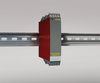
Advanced features. The 5114 transmitter can be configured, with or without a power supply, using the PReset software and the Loop Link communications unit. Application. Jumper selectable inputs for current/voltage or temperature. Programmable current (0...100 mA) and voltage (0...250 VDC) inputs. [See More]
- Inputs: Thermocouple Input; RTD Input
- Form Factor: DIN Rail
- Outputs: Analog Current Output; Analog Voltage Output
- Analog Input: 0...250 VDC -150...+150 mV; 0...100 mA
from OMEGA Engineering, Inc.
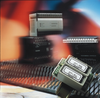
The DRP-8500 Series modules offer a low cost analog I/O solution for micro PLCs. The series is ideal for discrete automation applications requiring one or two analog I/O channels. All models in the series interface with the PLC high speed counter inputs or pulse outputs. Digital signal pulse-width... [See More]
- Inputs: Thermocouple Input; RTD Input; Bridge Input
- Form Factor: DIN Rail
- Outputs: Analog Current Output; Analog Voltage Output; Frequency or Pulse Output
- Analog Input: 0-10 V; 4-20 mA; 0-5000 Hz
from Acromag, Inc.
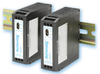
bull; DC voltage or DC current input. • DC voltage or DC current output. • Loop or DC or AC power. • Excellent accuracy and stability ensure reliable measurements in harsh industrial environments. Input isolated from output/power. These models convert sensor inputs to proportional... [See More]
- Inputs: Thermocouple Input
- Analog Channels: 1
- Outputs: Analog Current Output
- Differential Channels: Yes

from Define Instruments
This versatile 2-wire transmitter accepts a range of standard input types, and outputs a 4-20mA loop. USB programming is hassle free, and takes less than a minute using Define ToolBox. 2-wire universal transmitter (DIN-mount, isolated). Current, voltage, thermocouple, RTD and potentiometer input. [See More]
- Inputs: Thermocouple Input; Thermistor Input; RTD Input
- Analog Input: 100mV to ±10V; 1µA–24mA
- Form Factor: DIN Rail
- Excitation & Features: Voltage
from PR electronics
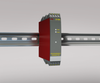
Application. Linearized, electronic temperature measurement with RTD or TC sensor. Conversion of linear resistance variation to a standard analog current / voltage signal, i.e. from solenoids and butterfly valves or linear movements with attached potentiometer. Power supply and signal isolator for... [See More]
- Inputs: Thermocouple Input; RTD Input
- Form Factor: DIN Rail
- Outputs: Analog Current Output; Relay Output
- Analog Input: 0...250 VDC -2500...+2500 mV; 0...100 mA

from OMEGA Engineering, Inc.
The DRF series DIN rail signal conditioners are designed to accept a broad range of input signals, such as ac and dc voltage and current, frequency, temperature (thermocouple and RTD), and process transducers, and provide standard process outputs of either 4 to 20 mA, or 0 to 10 Vdc. The DRF series... [See More]
- Inputs: Thermocouple Input; RTD Input; Bridge Input
- Form Factor: DIN Rail
- Outputs: Analog Current Output; Analog Voltage Output
- Analog Input: 0-650 V; 0-5 A; 0-650 V; 0-5 A; 0-50 kHz

from Define Instruments
What it does: The TM-4DPI accepts one of several input signal types and generates one of four commonly required outputs: 4-20mA, 0-20mA, 0-10V, &plusm;10V. The TM-4DPI is designed for applications that have an auxiliary supply to power the transmitter. It can be powered directly from a 24V DC... [See More]
- Inputs: Thermocouple Input; Thermistor Input; RTD Input
- Form Factor: DIN Rail
- Outputs: Analog Current Output; Analog Voltage Output
- Analog Input: 100mV to ±10V; 1µA–24mA
from PR electronics
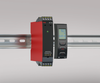
Advanced features. Programmable by way of detachable display front (4501), process calibration, signal simulation, password protection, error diagnostics and help text available in several languages. Application. Linearized, electronic temperature measurement with RTD or TC sensor. Conversion of... [See More]
- Inputs: Thermocouple Input; RTD Input
- Analog Input: 0...12 VDC; 0...20 mA
- Outputs: Analog Current Output; Analog Voltage Output
- T/C Type: E; J; K; N; T; B; S; R; W

from OMEGA Engineering, Inc.
The DRC-8900 Series DIN rail mount signal conditioners are ideal for a wide range of process monitoring applications. Models are available for a many different input types including thermocouples, RTDs, and process voltage or current. All models isolate and linearize. The thermocouple input models... [See More]
- Inputs: Thermocouple Input; RTD Input
- Form Factor: DIN Rail
- Outputs: Analog Current Output; Analog Voltage Output
- Analog Input: 0-100 V; 0-50 mA
from Define Instruments
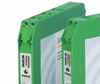
What it does: The Javelin accepts one of several popular input signal types and outputs a 4-20mA signal. Input types: RTD, mA, V, Pot, TC. The Javelin is a loop powered, isolated transmitter. One of its key features is its easy software setup using Define ToolBox. ToolBox enables simple and flexible... [See More]
- Inputs: Thermocouple Input; Thermistor Input; RTD Input
- Analog Channels: 1
- Outputs: Analog Current Output; Analog Voltage Output; Relay Output
- Form Factor: DIN Rail
from PR electronics
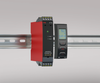
Advanced features. Programmable via detachable display front (4501), process calibration, signal and relay simulation, password protection, error diagnostics and selection of help text in several languages. Application. Linearized, electronic temperature measurement with RTD or TC sensor. Conversion... [See More]
- Inputs: Thermocouple Input; RTD Input
- Analog Input: 0...12 VDC; 0...20 mA
- Outputs: Analog Current Output; Analog Voltage Output; Relay Output
- T/C Type: E; J; K; N; T; B; S; R; W
from OMEGA Engineering, Inc.
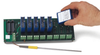
The OM7 Series modular isolation-based, single channel plug-in signal conditioning system accepts inputs from a wide range of process control transducers and signals while providing high-level output voltages. Featuring a maximum nonlinearity of 0.02% and factory calibrated to guarantee maximum... [See More]
- Inputs: Thermocouple Input; RTD Input
- Analog Channels: 1
- Outputs: Analog Current Output; Analog Voltage Output
- Form Factor: Stand-alone
from Define Instruments
The Sentry Trip Amplifier can be used for a myriad of control and alarm applications, and will also be at home in the signal conditioning arena. It accepts analog inputs from a range of industrial sensors, including: process, temperature, flow, frequency, and voltage from 200mV to 300V. It features... [See More]
- Inputs: Thermocouple Input; Thermistor Input; RTD Input; NTC, Digital Pulse, AC Current Sensor
- Analog Channels: 1
- Outputs: Analog Current Output; Analog Voltage Output; Relay Output
- Form Factor: DIN Rail

from OMEGA Engineering, Inc.
The DRF series DIN rail signal conditioners are designed to accept a broad range of input signals, such as ac and dc voltage and current, frequency, temperature (thermocouple and RTD), and process transducers, and provide standard process outputs of either 4 to 20 mA, or 0 to 10 Vdc. The DRF series... [See More]
- Inputs: Thermocouple Input
- Form Factor: DIN Rail
- Outputs: Analog Current Output; Analog Voltage Output
- User Interface: None