
Power Saving Modes Microcontrollers (MCU)
Last Updated: April 1, 2025
Description
Power Saving Modes Microcontrollers (MCUs) are designed to minimize power consumption by utilizing various low-power operating states. These modes allow the MCU to reduce its energy usage by transitioning into states such as 'wait' and 'sleep', where the high-power components like the CPU and memory are either slowed down or temporarily powered off when not in use.
Working Principle
Power Saving Modes in MCUs work by strategically managing the power states of the microcontroller's components. For instance, during periods of inactivity, the MCU can enter a 'wait' mode by gating the clock to the CPU, thereby reducing power consumption without completely shutting down. In more extreme cases, the MCU can enter a 'sleep' mode by removing power from the CPU, significantly lowering energy usage. These modes are useful because they extend battery life and reduce energy costs, especially in battery-powered applications, by ensuring that power is only used when necessary .
Applications
Power Saving Modes MCUs are particularly beneficial in battery-powered applications where energy efficiency is critical. For example, they are used in wearable devices, where long battery life is essential for user convenience. They are also employed in remote sensors that require minimal power consumption to operate over extended periods without frequent battery replacements .
Advantages over other Microcontrollers (MCU)
One significant advantage of Power Saving Modes MCUs is their ability to drastically reduce power consumption during inactive periods, which is not as effectively managed by traditional MCUs. For instance, the use of hardware accelerators in low-power MCUs can reduce the number of CPU cycles required for tasks like AES256 encryption from 7,000 to approximately 500 cycles, thereby lowering active processing time by more than 10 times .
Limitations
A limitation of Power Saving Modes MCUs is that the lowest power modes may come with trade-offs such as slow wake times, no state or RAM retention, or a reduced operating voltage range. These factors can limit the practicality of using the lowest power modes in real-world applications .
Considerations
When considering Power Saving Modes MCUs, it is important to evaluate the initial costs, which can be higher due to the advanced technology involved. Operating expenses may be lower due to reduced energy consumption, but developers must also consider the durability and accuracy of the MCU in low-power modes. Additionally, replacement and maintenance costs should be factored in, as the specific requirements of low-power applications may necessitate more frequent updates or replacements to maintain optimal performance .
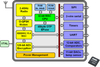
from Jennic Limited
The JN5139 is a low power, low cost wireless microcontroller suitable for IEEE802.15.4, Jennet and ZigBee applications. The device integrates a 32-bit RISC processor, with a fully compliant 2.4GHz IEEE802.15.4 transceiver, 192kB of ROM, 96kB of RAM, and a rich mixture of analogue and digital... [See More]
- Data Bus: 32 Bit
- Number: 3
- Life Cycle Stage: Maturity
- RAM: 96

from Silicon Labs
32-bit ARM Cortex-M3 MCU, 80 MHz frequency, 32 kB Flash, 8 kB RAM, AES, DMA, Low Power, LFO, RTC, Volt Reg, 300 mA IO, 40-pin, 6x6, QFN, EMIF, 2 x I2C, I2S, 3 x SPI, 4 x UART [See More]
- Data Bus: 32 Bit
- Clock Speed: 80
- Life Cycle Stage: New
- Interrupts: 16
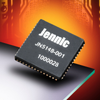
from Jennic Limited
The JN5148 is an ultra low power, high performance wireless microcontroller targeted at ZigBee PRO networking applications. The device features an enhanced 32-bit RISC processor offering high coding efficiency through variable width instructions, a multi-stage instruction pipeline and low power... [See More]
- Data Bus: 32 Bit
- Clock Speed: 32
- Life Cycle Stage: Maturity
- Number: 3
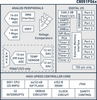
from Silicon Labs
The C8051F00x-01x family devices are highly integrated mixed-signal MCUs featuring a true 10 or 12-bit multi-channel ADC and two separate 12-bit DACs, two voltage comparators (F002/07/12/17 have one only), a voltage reference, and an 8051-compatible microcontroller core with 32 kB of FLASH memory. [See More]
- Data Bus: 8 Bit
- Clock Speed: 25
- Life Cycle Stage: Saturation
- Interrupts: 21
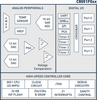
from Silicon Labs
The C8051F00x-01x family devices are highly integrated mixed-signal MCUs featuring a true 10 or 12-bit multi-channel ADC and two separate 12-bit DACs, two voltage comparators (F002/07/12/17 have one only), a voltage reference, and an 8051-compatible microcontroller core with 32 kB of FLASH memory. [See More]
- Data Bus: 8 Bit
- Clock Speed: 25
- Life Cycle Stage: Saturation
- Interrupts: 21
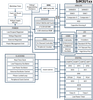
from Silicon Labs
32-bit ARM Cortex-M3 MCU, 80 MHz frequency, 32 kB Flash, 8 kB RAM, AES, DMA, Low Power, LFO, RTC, Volt Reg, 300 mA IO, 40-pin, 6x6, QFN, EMIF, 2 x I2C, I2S, 3 x SPI, USB, 4 x UART [See More]
- Data Bus: 32 Bit
- Clock Speed: 80
- Life Cycle Stage: New
- Interrupts: 16