
Tantalum / Tantalum Alloy Nonferrous Metals and Alloys
Description
Tantalum is a dark blue-grey, dense, ductile, very hard, brittle, and highly conductive metal. It is renowned for its exceptional corrosion resistance and high boiling point of 3017°C. Tantalum alloys are known for their good high-temperature strength and are used in various demanding environments. These alloys can be fabricated into different shapes and are often used where durability and resistance to harsh conditions are required.
Working Principle
Tantalum works effectively in environments where corrosion is a significant concern due to its high resistance to most acids and chemical solutions. Its high melting point and good strength at elevated temperatures allow it to maintain structural integrity in extreme conditions. Tantalum's ability to withstand corrosive environments makes it a valuable material in applications where long-term durability and reduced maintenance are critical. The metal's ductility and conductivity also contribute to its usefulness in various industrial applications.
Applications
Tantalum is widely used in the electronics industry, particularly in the production of tantalum capacitors found in cell phones, DVD players, game systems, and computers. It is also utilized in laboratory equipment and as a substitute for platinum. In the chemical and petrochemical industries, tantalum is used in heat exchangers, condensers, columns, reactors, helical coils, pipe spools, and valve linings. Its corrosion resistance makes it suitable for use in environments exposed to extremely corrosive fluids. Additionally, tantalum alloys are employed in aerospace products due to their high-temperature strength.
Advantages over other Nonferrous Metals and Alloys
Tantalum outperforms many other materials in terms of corrosion resistance, making it the material of choice in applications where long-term benefits such as reduced downtime and increased life expectancy are important. Its ability to handle increased pressure and temperature without succumbing to corrosion problems gives it an edge over other nonferrous metals. Tantalum's high melting point and strength at elevated temperatures allow for the use of thinner sections, which can be cost-effective despite the metal's high expense.
Limitations
Tantalum can suffer from severe embrittlement when exposed to high-temperature oxygen or nitrogen, or with hydrogen at any temperature. It is also attacked by strong alkaline solutions and fused alkalies like sodium hydroxide. Additionally, tantalum alloys oxidize rapidly, requiring surface coatings for elevated temperature service in oxidizing environments. The high cost of tantalum can be a limiting factor for its use in some applications.
Considerations
When considering the use of tantalum or tantalum alloys, initial costs can be high due to the expense of the raw material. However, the long-term benefits of reduced maintenance and downtime can offset these costs. Tantalum's durability and resistance to corrosion contribute to its longevity, reducing replacement and maintenance expenses over time. Engineers must weigh the high initial investment against the potential for increased efficiency and reduced operational costs in corrosive environments.
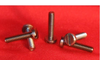
from Thermo Shield
Included in our stock of inch and metric refractory fasteners is Molybdenum (Mo or Moly), Tantalum (Ta), Tungsten (W), and Alumina (Al2O3 or AD998) screws (fillister, flat & pan head), nuts (hex, square, round with flat or double d, & round slotted), washers (flat, thin, & shoulder), threaded rod,... [See More]
- Nonferrous: Refractory / Reactive; Tantalum
- Shape / Form: Fabricated Parts or Shapes (Castings, Forgings, Machined Parts, etc.); Semi-finished, Mill Stock or Near Net Shapes; Fasteners

from Leading Edge Metals & Alloys, Inc.
Like niobium, tantalum is a heat-tolerant refractory metal with excellent corrosion resistance. Often alloyed with other metals, tantalum is used to make super alloys used in chemical processing, jet engines and nuclear reactors. Its oxidation properties also make it an excellent choice for many... [See More]
- Nonferrous: Refractory / Reactive; Tantalum
- Shape / Form: Semi-finished, Mill Stock or Near Net Shapes (optional feature); Bar Stock (optional feature); Plate (optional feature); Sheet (optional feature); Wire (optional feature)
- Specialty / Other Types: Alloy
- Thickness: 1.00E-3 to 2

from Matexcel
Storage: Store at room temperature. Purity: 0.999. Size: 3um; 10um; 100mesh; 325mesh [See More]
- Nonferrous: Tantalum
- Shape / Form: Powder, Granule or Flake
- Specialty / Other Types: Pure, Unalloyed or Very Low Alloy Additions
- Length: 1.18E-4 to 3.94E-4

from Ed Fagan, Inc.
Tantalum is famous for its resistance to corrosion by acids; in fact, below 150 ˚C, tantalum is almost completely immune to corrosion by aqua regia. Due to its resistance to attack by body fluids, tantalum provides an excellent material for medical devices. Another major use of Tantalum is for... [See More]
- Nonferrous: Refractory / Reactive; Tantalum
- Specifications: ASTM / ASME; AMS 7849
- Specialty / Other Types: Alloy
- Shape / Form: Semi-finished, Mill Stock or Near Net Shapes; Coil Stock (optional feature); Foil (optional feature)
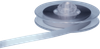
from Plansee SE
MY-ESS ribbons are used to conduct electricity reliably to high intensity discharge lamps (HID lamps). Thanks to their special geometry, they reduce the stress at the boundary between the surrounding glass and the electrically conductive ribbon. Inside the lamp, the tungsten electrode must be... [See More]
- Nonferrous: Refractory / Reactive; Molybdenum; Tantalum
- Shape / Form: Semi-finished, Mill Stock or Near Net Shapes; Strip

from Ulbrich Stainless Steels & Special Metals, Inc.
Tantalum Shaped, Flat, Square, Round, Fine Wire, Plated and Un-plated. ASTM B 365, ASTM B708, ASTM F 560. R05200: Electron beam or vacuum-arc cast tantalum. R05400: Sintered tantalum. TANTALUM WIRE DESCRIPTION. Tantalum Alloy Description. Tantalum is ductile, superconductive, has high-temperature... [See More]
- Nonferrous: Refractory / Reactive; Tantalum
- UNS Number: 5200 to 5400
- Specialty / Other Types: Alloy
- Specifications: ASTM / ASME; UNS
from Materion Corporation
Pre-melted evaporation cones and discs. Standard Temescal/Telemark sizes or custom sized to fit your pocket or crucible. Rods for continuous processes [See More]
- Nonferrous: Refractory / Reactive; Tantalum
- Shape / Form: Semi-finished, Mill Stock or Near Net Shapes; Bar Stock; Round Bar or Rod Stock; Cone, Disk
- Specialty / Other Types: Alloy; LightAlloy
- Applications: Electronics or semiconductors; Semiconductor, Optical Coating

from Umicore Metal Deposition Solutions
Coating material. Tantalum. Purity. 99.9%. Form. Disc. Dimensions. Ø 21 x 5 mm. Quantity. 1 pc. Theoretical density at 20 °C in g/cm ³. 16.6. Melting point in °C. 3017. 10 ⁻ ² mbar in °C. 3040. 10 ⁻ ¹ mbar in °C. 3310. Boiling point in °C. [See More]
- Nonferrous: Refractory / Reactive; Tantalum
- Width / OD: 0.8268
-
Shape / Form: Semi-finished, Mill Stock or Near Net Shapes;
Disc
- Length: 0.1969

from ATI
Niobium, Hafnium, Tantalum, & Vanadium Alloys [See More]
- Nonferrous: Tantalum; Niobium / Niobium Alloy
- Shape / Form: Semi-finished, Mill Stock or Near Net Shapes

from Thermo Shield
Material below .005 inches in thickness is classified as tantalum refractory foil. Typical uses for it are electronic components, metallizing sources, furnace insulation/liner and chemically etched parts. [See More]
- Nonferrous: Refractory / Reactive; Tantalum
- Thickness: 1.00E-3 to 0.0040
- Shape / Form: Semi-finished, Mill Stock or Near Net Shapes; Foil
- Width / OD: 12

from Plansee SE
We can supply you with rivets, screws and nuts made of molybdenum, tungsten, tantalum and niobium as well as a wide range of alloys that perfectly meet the needs of your project. Our range includes hexagon rivets, round head rivets and combination rivet shapes. Our line in screws comprises both... [See More]
- Nonferrous: Refractory / Reactive; Molybdenum; Tantalum; Niobium / Niobium Alloy; Tungsten
- Shape / Form: Fabricated Parts or Shapes (Castings, Forgings, Machined Parts, etc.); Screws, Rivets and Bolts