
Toggle Switches Information
Last revised: January 14, 2025
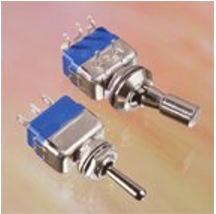
Toggle switches are actuated by moving a lever back and forth to open or close an electrical circuit. There are two basic types: maintained contact and momentary contact.
Maintained contact toggle switches maintain the position to which they are moved or actuated. Momentary contact toggle switches do not. Both types of toggle switches can use short (.5-in.), ball (<.75-in.), standard (.75-in.), or long (1.5-in) handles.
Specifications
Important specifications for toggle switches include dimensions, electrical ratings, terminal types, materials and features.
Physical Specifications
- Length or diameter
- Width
- Panel thickness
Electrical Specifications
- Maximum current rating
- Maximum AC voltage rating
- Maximum DC voltage rating
- Maximum power rating
Terminal Types
- Feed-through style
- Solder terminals
- Screw terminals
- Quick connect or blade terminals
- Surface mount technology (SMT)
- Straight PC pins
- Right angle PC pins
- Side PC pins
Materials
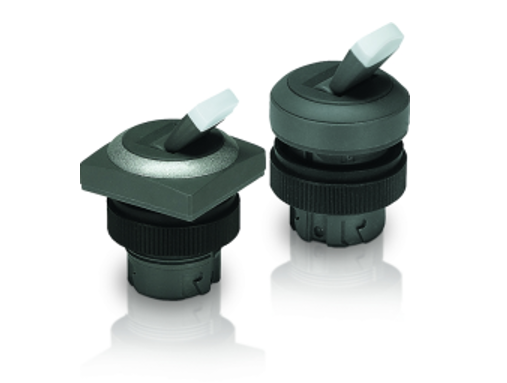
Most toggle switch bases and toggle switch actuators are made of plastic, thermoplastic, or metal materials.
Features
- Pilot light or illumination
- Imprinted markings
- Wiping contacts
- Locking mechanism
- Time delay
- CE certification
- CSA certification
- UL listing
- Dustproof
- Weather resistant
- Waterproof
Configuration
Maintained-contact toggle switches and momentary-contact toggle switches differ in terms of switch configuration.
Configurations for maintained-contact toggle switches are described below.
- ON/OF toggle switches have separate ON and OFF functions and work like light switches.
- Three-position toggle switches have a center position that may or may not perform an OFF function.
Switch functions for momentary-contact toggle switches include the following.
- Momentary ON describes contacts which interrupt the circuit when the toggle switch is in the normal, open (NO) position.
- Momentary OFF describes contacts which establish a circuit when the toggle switch is in the normal, closed (NC) position.
- Alternate ON/OFF describes a switch where the first actuation turns the toggle switch ON and the second actuation turns the toggle switch OFF.
- Three-position momentary center-NEUTRAL toggle switches have a center position that can perform an OFF or NEUTRAL function.
There are several configurations for pole and throw toggle switches.
Single pole single throw (SPST) toggle switches make or break the connection of a single conductor in a single branch circuit. This switch type typically has two terminals and is referred to as a single-pole switch.
Single pole double throw (SPDT) toggle switches make or break the connection of a single conductor with either of two other single conductors. These switches usually have three terminals and are commonly used in pairs. SPDT switches are sometimes called three-way switches.
Double pole single throw (DPST) toggle switches make or break the connection of two circuit conductors in a single branch circuit. They usually have four terminals.
Double pole double throw (DPDT) toggle switches make or break the connection of two conductors to two separate circuits. They usually have six terminals are available in both momentary and maintained contact versions.
A normally open (NO) toggle switch has contacts that are open or disconnected in their unactuated (normal) position.
A normally closed (NC) toggle switch has contacts that are closed or connected in their unactuated (normal) position.
Standards
EIA-480—Toggle switches
EIA-520D000—Sectional specification for toggle, paddle, and rocker switches
EIA-520DAAA—Detail specification on 1 pole toggle switches
Toggle Switches FAQs
How do different toggle switch configurations impact their performance in various engineering environments?
Electromechanical Switches: These switches have mechanical contacts and can handle a wide range of current and voltage options. They are not affected by environmental factors like dirt or temperature extremes but have disadvantages such as limited contact life and slower switching speeds.
Solid-State Switches: These switches do not have moving parts, allowing for faster switching without sparking or contact corrosion. They are more reliable and long-lasting but may have higher insertion loss compared to electromechanical switches.
What are the benefits of using solid-state switches in engineering applications?
Fast Switching: Solid-state switches can switch faster than electromechanical switches because they do not have moving parts that can cause delays or contact bounce.
Reliability and Longevity: Due to the absence of mechanical parts, solid-state switches are more resistant to shock, vibration, and mechanical wear, making them more reliable and long-lasting compared to their electromechanical counterparts.
No Sparking or Contact Corrosion: These switches do not experience sparking between contacts or problems with contact corrosion, which can be a significant advantage in environments where such issues could lead to failures or safety hazards.
Resistance to Environmental Factors: Solid-state switches are less affected by environmental factors such as dirt, mist, and temperature extremes, which can be beneficial in harsh or variable environments.
However, it's important to note that solid-state switches may have higher insertion loss compared to electromechanical switches and can be more costly to build for very high current ratings.
What are the disadvantages of solid-state switches?
Solid-state switches, while offering several advantages, also have some disadvantages that are important to consider in engineering applications:
High Cost for High Current Ratings: One of the main disadvantages of solid-state switches is the high cost associated with building them for very high current ratings. This can make them less economically viable for applications requiring high power handling.
Higher Insertion Loss: Compared to electromechanical switches, solid-state switches are prone to higher insertion loss. This means that there can be a greater loss of signal power when the signal passes through the switch, which can be a critical factor in applications where signal integrity is paramount.
These disadvantages should be weighed against the benefits of solid-state switches, such as their fast switching capabilities, reliability, and resistance to environmental factors, to determine their suitability for specific engineering applications.
What are the advantages of electromechanical switches?
Wide Range of Current and Voltage Options: Electromechanical switches can control a broader range of current and voltage options, making them versatile for various applications.
Environmental Resistance: These switches are not affected by environmental factors such as dirt, mist, magnetic fields, or temperature extremes, ranging from near absolute zero to 1,000° C.
Adaptability: Electromechanical switches can adapt to misalignment in installation or application, ensuring there is no leakage current. This adaptability makes them suitable for many circuitry, actuator, and housing styles.
Low Signal Loss and Minimal Cross Talk: In RF applications, electromechanical switches feature low signal loss and minimal cross talk between channels, which is beneficial for maintaining signal integrity.
Power Density: Electromechanical relays provide excellent power density, which is advantageous for applications requiring high power handling.
How do electromechanical switches compare to solid-state switches in terms of reliability?
Mechanical Wear and Tear
Electromechanical Switches: These switches have moving parts, which can lead to mechanical wear and tear over time. This can result in slower switching speeds and potential reliability issues due to contact bounce and arcing between contacts.
Solid-State Switches: These switches do not have moving parts, which makes them more resistant to mechanical wear and tear. As a result, they are generally considered more reliable and long-lasting compared to electromechanical switches.
Resistance to Environmental Factors
Electromechanical Switches: They are not affected by environmental factors such as dirt, mist, magnetic fields, or temperature extremes, which can contribute to their reliability in harsh conditions.
Solid-State Switches: These switches are also resistant to environmental factors and are less affected by shock and vibration, further enhancing their reliability.
Switching Speed and Performance
Electromechanical Switches: The physical movement required for switching can lead to slower performance and potential reliability issues due to contact bounce.
Solid-State Switches: They switch faster without sparking or contact corrosion, which contributes to their reliability, especially in applications requiring rapid switching.
Durability and Longevity
Electromechanical Switches: While they offer excellent power density, their durability and reliability can be limited by mechanical factors, especially in applications with high inrush currents or inductive loads.
Solid-State Switches: They are regarded as more reliable and long-lasting due to their superior resistance to mechanical wear and environmental factors.
What are the specific applications where solid-state switches are preferred over electromechanical switches?
High-Speed Switching Applications: Solid-state switches are ideal for applications requiring fast switching speeds because they do not have moving parts that can cause delays or contact bounce.
Environments with Shock and Vibration: Due to their resistance to shock, vibration, and mechanical wear, solid-state switches are preferred in environments where these factors are prevalent, ensuring higher reliability and longevity.
Applications Requiring Silent Operation: Solid-state switches enable silent operations, making them suitable for applications where noise reduction is important.
High-Performance Applications: In scenarios where system reliability and longevity are critical, such as in high-performance applications, solid-state switches are often chosen over electromechanical switches due to their superior durability and resistance to environmental factors.
Applications with High Inrush Currents or Inductive Loads: Solid-state switches are increasingly replacing electromechanical relays in applications that involve controlling a wide range of loads with capacitive or inductive characteristics, where system availability and reliability are a concern.
These applications leverage the benefits of solid-state switches, such as fast switching, reliability, and resistance to environmental factors, despite their higher cost and potential for higher insertion loss compared to electromechanical switches.
How do environmental factors influence the performance of toggle switches?
Environmental factors can significantly influence the performance of toggle switches in various ways. Here are some key considerations:
Temperature Extremes
High temperatures can lead to overheating, potentially damaging sensitive electrical components within the switch.
Low temperatures can cause issues such as the formation of ice in actuator wells if moisture is present, which can affect switch operation.
Humidity and Moisture
Humid environments can impact the consistency of contact lubricants, which may affect the switch's performance. High humidity combined with corrosive environments can exacerbate these effects.
Contaminants and Chemicals
Environmental contaminants such as dust, dirt, and chemically active liquids can cause mechanical switches to malfunction by making contacts stick or remain open.
Oils and chemicals from industrial machinery can infiltrate switches, affecting internal circuitry. Sealing solutions like boots and bushings can help prevent such intrusions.
Shock and Vibration
Switches exposed to shock and vibration may experience mechanical wear, which can affect their reliability and longevity. Solid-state switches are generally more resistant to these factors compared to electromechanical switches.
Sealing and Protection
Using sealed switches or adding protective boots can help mitigate the effects of harsh environments by providing a barrier against contaminants and maintaining switch integrity.
Toggle Switches Media Gallery
References
Electronics360—An Introduction to RF Switch Technology
GlobalSpec—White Paper: Solid-State Relays with Optimized Superjunction FET Technology
Image credits:
Heilind Electronics, Inc. | RAFI GmbH & Co. KG
- Ball Handle
- CSA Certified
- DPDT
- DPST
- Dustproof
- Illuminated Switch
- Locking Switch
- Long Toggle Handle
- Maintained Contact
- Metallic
- Metallic
- Momentary Contact
- Momentary OFF (Normally Closed)
- Momentary ON (Normally Open)
- ON / OFF
- Pilot Light
- Quick Connect / Blade
- Right Angle PC Pins
- RoHS Compliant
- SPDT
- SPST
- Screw Terminals
- Short Toggle Handle
- Solder Terminals
- Standard Toggle Handle
- Straight PC Pins
- Thermoplastic / Plastic
- Thermoplastic / Plastic
- Three Position (Center OFF)
- Three Position (No Center OFF)
- Three Position Momentary (Center NEUTRAL)
- Three Position Momentary (Center OFF)
- Three Position Momentary (Center ON)
- UL listed
- Weather Resistant or Waterproof
- Wiping Contacts
- Wire Leads
- high voltage toggle switch
- toggle switch guard
- hydraulic toggle switch
- long handle toggle switches
- 110 volt toggle switches
- 120V DC toggle switches
- 12v 4 way toggle switches
- 15a 120V toggle switches
- 2 position momentary toggle switches
- 20 amp DPST toggle switches
- 20a 120V toggle switches
- 24 volt toggle switches
- 240V toggle switches
- 24V DC toggle switches
- 3 way air toggle switches
- 4 way momentary toggle switches
- 40 amp toggle switches
- 48V DC toggle switches
- 6pdt toggle switches
- DIN rail mounted toggle switches
- dp4t toggle switches
- DPDT reversing toggle switches
- flight simulator toggle switches
- locking lever toggle switches
- microphone toggle switches
- non latching toggle switches
- sptt toggle switches
- thermal overload toggle switches