
# 0 Studs
Last Updated: February 12, 2025
Description
0 Studs are small, threaded fasteners used to join materials together. They are typically made from various materials, including metals and non-metals, and are designed to provide a secure and stable connection between components.
Working Principle
Studs work by being threaded into a pre-drilled hole or being welded onto a surface. The threading allows for a tight fit, ensuring that the materials being joined remain securely in place. Stud welding, in particular, is a process that involves the instantaneous joining of a stud to a workpiece, which is achieved by creating an arc between the stud and the surface. This method is useful because it provides a strong bond with minimal heat distortion and requires access from only one side of the workpiece, making it efficient and versatile for various applications .
Applications
Studs are used in a wide range of applications. For example, in the construction industry, they are used as concrete anchors or shear connectors in composite beam designs. In shipbuilding, stud welding has replaced traditional methods, improving the quality and efficiency of ship construction. They are also used in automotive and electronics industries for mounting components securely .
Advantages over other Studs
Stud welding offers several advantages over traditional stud mounting methods. It reduces time and cost due to its instantaneous welding process without sacrificing quality. The low heat influence of stud welding eliminates distortion, and it requires only single-side access to perform the task, making it a preferred choice in many industries .
Limitations
One limitation of using studs, particularly in welding applications, is the need for proper specification and due diligence to ensure the correct stud length and material are used for the application. For instance, in corrosive environments, stainless steel studs are necessary, and in cyclic loading conditions, annealing may be required to prevent failure .
Considerations
When considering the use of studs, factors such as initial costs, operating expenses, durability, and maintenance should be evaluated. The choice of material, such as carbon steel, stainless steel, or aluminum, can affect the cost and durability of the studs. Additionally, the specific application and environmental conditions will influence the selection of the appropriate stud type and material to ensure longevity and performance .

from PennEngineering®
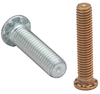
These studs ensure permanent mounting in metal sheets as thin as .062 in. The fastener head is locked securely in a blind, milled hole and is able to handle substantial loads. The concealed-head feature allows the side of the sheet opposite installation to remain smooth. Sheet preparation only... [See More]
- Inch: # 0; # 10
- Shape: Round
- Attachment: Pressed
- Design Units: English
from PennEngineering®
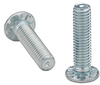
PEM ® self-clinching studs are installed by placing them in properly sized holes in the sheets and squeezing into place with any standard press. The squeezing action embeds the head of the stud into the sheet. The metal displaced by the head flows smoothly and evenly around the ribs and into the... [See More]
- Inch: # 0; # 10
- Shape: Round
- Attachment: Pressed
- Design Units: English
from PennEngineering®
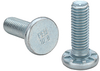
PEM ® self-clinching studs are installed by placing them in properly sized holes in the sheets and squeezing into place with any standard press. The squeezing action embeds the head of the stud into the sheet. The metal displaced by the head flows smoothly and evenly around the ribs and into the... [See More]
- Inch: # 0; # 10
- Shape: Round
- Attachment: Pressed
- Design Units: English
from PennEngineering®
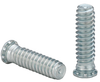
PEM ® self-clinching studs are installed by placing them in properly sized holes in the sheets and squeezing into place with any standard press. The squeezing action embeds the head of the stud into the sheet. The metal displaced by the head flows smoothly and evenly around the ribs and into the... [See More]
- Inch: # 0; # 10
- Shape: Round
- Attachment: Pressed
- Design Units: English
from PennEngineering®
PEM ® self-clinching studs are installed by placing them in properly sized holes in the sheets and squeezing into place with any standard press. The squeezing action embeds the head of the stud into the sheet. The metal displaced by the head flows smoothly and evenly around the ribs and into the... [See More]
- Inch: # 0; # 10
- Shape: Round
- Attachment: Pressed
- Design Units: English

from PennEngineering®
PEM ® self-clinching studs are installed by placing them in properly sized holes in the sheets and squeezing into place with any standard press. The squeezing action embeds the head of the stud into the sheet. The metal displaced by the head flows smoothly and evenly around the ribs and into the... [See More]
- Inch: # 0; # 10
- Shape: Round
- Attachment: Pressed
- Design Units: English

from PennEngineering®
PEM ® self-clinching studs are installed by placing them in properly sized holes in the sheets and squeezing into place with any standard press. The squeezing action embeds the head of the stud into the sheet. The metal displaced by the head flows smoothly and evenly around the ribs and into the... [See More]
- Inch: # 0; # 10
- Shape: Round
- Attachment: Pressed
- Design Units: English
from PennEngineering®
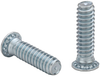
PEM ® self-clinching studs are installed by placing them in properly sized holes in the sheets and squeezing into place with any standard press. The squeezing action embeds the head of the stud into the sheet. The metal displaced by the head flows smoothly and evenly around the ribs and into the... [See More]
- Inch: # 0; # 10
- Shape: Round
- Attachment: Pressed
- Design Units: English
from PennEngineering®
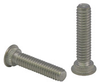
PEM Type SGPC swaging collar studs can install into most panel material, provide strong torque-out resistance and are suitable for close centerline-to-edge situations. These studs can also accommodate multiple panels as long as the total thickness does not exceed the maximum sheet thickness. [See More]
- Inch: # 0; # 10
- Shape: Round
- Attachment: Pressed
- Design Units: English

from Bayou City Bolt & Supply Co., Inc.
All thread rods and studs are used for general purpose fastening for anything from an anchor bolt to a through bolt. A variety of grades and materials are available including stainless steel. Threaded rod is available in a variety of strengths. Low carbon all thread and studs are usually provided in... [See More]
- Inch: # 0000; # 000; # 00; # 0; # 1; # 2; # 3; # 4; # 5; # 6; # 7; # 8; # 9; # 10; # 12; # 14; 1/4"; # 16; # 18; 5/16"; # 20; # 24; 3/8"; 7/16"; 1/2"; 5/8"; 3/4"; 7/8"; 1"; 1 1/8"; 1 1/4"; 1 3/8"; 1 1/2"; 1 3/4"; 2"; 2 1/4"; 2 1/2"; 2 3/4"; 3"; As Specified
- Shape: Round
- Attachment: Threaded
- Design Units: English