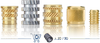
Help with Threaded Inserts specifications:
Installation Method
Back to Top

|
| ||
| Installation Method | |||
| Your choices are... | |||
| Epoxied-In | Epoxied-in threaded inserts are epoxied in place without a tapped or molded hole. | ||
| Molded-In | Molded-in threaded inserts are molded-in to the plastic during the molding process. This installation method is used with thermoset plastics. | ||
| Pressed-In | Pressed-in threaded inserts are pressed into a hole without the use of special tools. | ||
| Self-tapping | Self-tapping threaded inserts are also called thread forming or thread cutting inserts. They do not require a pre-drilled or pre-molded hole. | ||
| Thermal | Thermal threaded inserts are placed into a pre-molded or pre-drilled hole. A heated probe heats the insert and pressure is applied. The heated insert melts the base material locally, allowing it to flow into and around the grooves and knurls. When the probe is removed, the base material solidifies and locks the insert in place. Thermal installation is not used with thermoset plastics. | ||
| Threaded Hole | Threaded-hole inserts can be either solid, metal-threaded inserts or precision-formed, screw-thread coils. They are installed in tapped holes. Threaded-hole inserts are often used as thread repair inserts. Heli-Coil® inserts (Emhart Teknologies) are threaded-hole inserts that are made of stainless steel and that have a diamond-shaped cross-section. They are installed into Heli-Coil tapped holes. | ||
| Ultrasonic | With ultrasonic threaded inserts, electronic energy is converted to a high-frequency mechanical vibration and the threaded insert is placed in a pre-molded or pre-drilled holed. The ultrasonic tool is pressed on the insert and vibration is transmitted, causing friction to melt a thin film of resin. The insert is pressed into the hole, the tool is removed, and the liquefied base material solidifies, locking the insert in place. Ultrasonic installation is not meant for use with thermoset plastics. | ||
| Other | Other unlisted, specialized, or proprietary installation method. | ||
| Search Logic: | All products with ANY of the selected attributes will be returned as matches. Leaving all boxes unchecked will not limit the search criteria for this question; products with all attribute options will be returned as matches. | ||
| |||
Base Materials
Back to Top
|
|
| ||
| Base Materials | |||
| Your choices are... | |||
| Ceramic | Threaded inserts are designed for installation in ceramic materials. | ||
| Metal | Threaded inserts are designed for installation in metal materials. | ||
| Plastic | Threaded inserts are designed for installation in plastic materials. The thermal and ultrasonic installation methods can only be used with thermoplastic materials. | ||
| Rubber | Threaded inserts are designed to be installed in natural or synthetic rubber materials. | ||
| Wood | Threaded inserts are designed for installation in wooden materials. | ||
| Other | Other unlisted, specialized, or proprietary base materials. | ||
| Search Logic: | All products with ANY of the selected attributes will be returned as matches. Leaving all boxes unchecked will not limit the search criteria for this question; products with all attribute options will be returned as matches. | ||
| |||
Internal Thread Specifications
Back to Top
|
|
| ||
| Inch | |||
| Your choices are... | |||
| # 0000 | # 0000 fasteners have an inner diameter of 0.021 in. | ||
| # 000 | # 000 fasteners have an inner diameter of 0.034 in. | ||
| # 00 | # 00 fasteners have an inner diameter of 0.047 in. | ||
| # 0 | # 0 fasteners have an inner diameter of 0.060 in. | ||
| # 1 | # 1 fasteners have an inner diameter of 0.073 in. | ||
| # 2 | # 2 fasteners have an inner diameter of 0.086 in. | ||
| # 3 | # 3 fasteners have an inner diameter of 0.099 in. | ||
| # 4 | # 4 fasteners have an inner diameter of 0.112 in. | ||
| # 5 | # 5 fasteners have an inner diameter of 0.125 in. | ||
| # 6 | # 6 fasteners have an inner diameter of 0.138 in. | ||
| # 7 | # 7 fasteners have an inner diameter of 0.151 in. | ||
| # 8 | # 8 fasteners have an inner diameter of 0.164 in. | ||
| # 9 | # 9 fasteners have an inner diameter of 0.177 in. | ||
| # 10 | # 10 fasteners have an inner diameter of 0.190 in. | ||
| # 12 | # 12 fasteners have an inner diameter of 0.216 in. | ||
| # 14 | # 14 fasteners have an inner diameter of 0.242 in. | ||
| 1/4" | 1/4" fasteners have an inner diameter of .250 in. | ||
| # 16 | # 16 fasteners have an inner diameter of 0.268 in. | ||
| # 18 | # 18 fasteners have an inner diameter of 0.294 in. | ||
| 5/16" | 5/16" fasteners have an inner diameter of .3125 in. | ||
| # 20 | # 20 fasteners have an inner diameter of 0.320 in. | ||
| # 24 | # 24 fasteners have an inner diameter of 0.372 in. | ||
| 3/8" | 3/8" fasteners have an inner diameter of .375 in. | ||
| 7/16" | 7/16" fasteners have an inner diameter of .4375 in. | ||
| 1/2" | 1/2" fasteners have an inner diameter of .500 in. | ||
| 5/8" | 5/8" fasteners have an inner diameter of .625 in. | ||
| 3/4" | 3/4" fasteners have an inner diameter of .750 in. | ||
| 7/8" | 7/8" fasteners have an inner diameter of .875 in. | ||
| 1" | 1" fasteners have an inner diameter of 1.000 in. | ||
| 1 1/8" | 1 1/8" fasteners have an inner diameter of 1.125 in. | ||
| 1 1/4" | 1 1/4" fasteners have an inner diameter of 1.250 in. | ||
| 1 3/8" | 1 3/8" fasteners have an inner diameter of 1.375 in. | ||
| 1 1/2" | 1 1/2" fasteners have an inner diameter of 1.500 in. | ||
| 1 3/4" | 1 3/4" fasteners have an inner diameter of 1.750 in. | ||
| 2" | 2" fasteners have an inner diameter of 2.000 in. | ||
| 2 1/4" | 2 1/4" fasteners have an inner diameter of 2.250 in. | ||
| 2 1/2" | 2 1/2" fasteners have an inner diameter of 2.500 in. | ||
| 2 3/4" | 2 3/4" fasteners have an inner diameter of 2.750 in. | ||
| 3" | 3" fasteners have an inner diameter of 3.000 in. | ||
| Other | Other, unlisted inch-based sizes. | ||
| Search Logic: | Products with the selected attribute will be returned as matches. Leaving or selecting "No Preference" will not limit the search criteria for this question; products with all attribute options will be returned as matches. | ||
| |||
| Metric | |||
| Your choices are... | |||
| M1.6 | M1.6 fasteners have an inner diameter of 1.6 mm. | ||
| M2 | M2 fasteners have an inner diameter of 2.0 mm. | ||
| M2.5 | M2.5 fasteners have an inner diameter of 2.5 mm. | ||
| M3 | M3 fasteners have an inner diameter of 3.0 mm. | ||
| M3.5 | M3.5 fasteners have an inner diameter of 3.5 mm. | ||
| M4 | M4 fasteners have an inner diameter of 4.0 mm. | ||
| M5 | M5 fasteners have an inner diameter of 5.0 mm. | ||
| M6 | M6 fasteners have an inner diameter of 6.0 mm. | ||
| M8 | M8 fasteners have an inner diameter of 8.0 mm. | ||
| M10 | M10 fasteners have an inner diameter of 10.0 mm. | ||
| M12 | M12 fasteners have an inner diameter of 12.0 mm. | ||
| M14 | M14 fasteners have an inner diameter of 14 mm. | ||
| M16 | M16 fasteners have an inner diameter of 16 mm. | ||
| M18 | M18 fasteners have an inner diameter of 18 mm. | ||
| M20 | M20 fasteners have an inner diameter of 20 mm. | ||
| M22 | M22 fasteners have an inner diameter of 22 mm. | ||
| M24 | M24 fasteners have an inner diameter of 24 mm. | ||
| M25 | M25 fasteners have an inner diameter of 25 mm. | ||
| M26 | M26 fasteners have an inner diameter of 26 mm. | ||
| M27 | M27 fasteners have an inner diameter of 27 mm. | ||
| M28 | M28 fasteners have an inner diameter of 28 mm. | ||
| M30 | M30 fasteners have an inner diameter of 30 mm. | ||
| M32 | M32 fasteners have an inner diameter of 32 mm. | ||
| M33 | M33 fasteners have an inner diameter of 33 mm. | ||
| M35 | M35 fasteners have an inner diameter of 35 mm. | ||
| M36 | M36 fasteners have an inner diameter of 36 mm. | ||
| M38 | M38 fasteners have an inner diameter of 38 mm. | ||
| M40 | M40 fasteners have an inner diameter of 40 mm. | ||
| M42 | M42 fasteners have an inner diameter of 42 mm. | ||
| M48 | M48 fasteners have an inner diameter of 48 mm. | ||
| M56 | M56 fasteners have an inner diameter of 56 mm. | ||
| M64 | M64 fasteners have an inner diameter of 64 mm. | ||
| Other | Other, unlisted metric sizes. | ||
| Search Logic: | Products with the selected attribute will be returned as matches. Leaving or selecting "No Preference" will not limit the search criteria for this question; products with all attribute options will be returned as matches. | ||
| |||
Length
Back to Top
|
|
| ||
| Insert Length | The length of the fastener. Holes should be at least the length of the insert plus .030" or an internal pitch length, whichever is greater. Holes for tapping inserts should be at least 1.2 times the length of the insert. In the case of blind holes, care must be taken so that the screw being specified does not bottom out in the hole. | ||
| Search Logic: | User may specify either, both, or neither of the "At Least" and "No More Than" values. Products returned as matches will meet all specified criteria. | ||
| |||
Kit Availability
Back to Top
|
|
| ||
| Available in Kits | |||
| Your choices are... | |||
| Assorted Sizes | Inserts are supplied in a kit that contains assorted sizes of the same insert. | ||
| Thread Repair Kits | Thread repair kits contain more than one of the following items: threaded inserts, taps, insert tools, or drill bits. | ||
| Search Logic: | All products with ANY of the selected attributes will be returned as matches. Leaving all boxes unchecked will not limit the search criteria for this question; products with all attribute options will be returned as matches. | ||
| |||
Material / Finish
Back to Top
|
|
| ||
| Metallic | |||
| Your choices are... | |||
| Aluminum | Aluminum is a bluish, silver-white, malleable, ductile, light, trivalent, metallic element that has good electrical and thermal conductivity, high reflectivity, and resistance to oxidation. Aluminum is lighter than steel, but not as strong. | ||
| Brass | Brass provides good strength, excellent high-temperature ductility, reasonable cold ductility, good conductivity, excellent corrosion resistance, good bearing properties and low magnetic permeability. | ||
| Bronze / Copper Base Alloy | A copper base alloy is a metal with copper as the main alloying metal and one or more other metals, such as tin, zinc, or phosphorus. Silicon bronze is a typical fastener alloy. | ||
| Copper | Copper is a common, reddish, metallic element that is both ductile and malleable. Copper is one of the best conductors of heat and electricity. It also exhibits good corrosion resistance. | ||
| Inconel® / Incoloy® | Inconel® and Incoloy® (Special Metals Corporation) provide good strength and excellent resistance to oxidation and carbonization in high temperatures environments, and in many aqueous environments. These proprietary materials are used in process piping, heat exchangers, heating element sheathing and nuclear steam generator tubing. Typically, Inconel and Incoloy are used at service temperatures below 650° C (1200° F). | ||
| Monel® | Monel® (Special Metals Corporation) is a proprietary, high-strength material that offers resistance to a range of corrosive media such as seawater, hydrofluoric and sulfuric acids, and alkalis. | ||
| Steel | Steel is a commercial iron that contains carbon in any amount up to about 1.7 percent as an essential alloying constituent. Many grades of carbon and alloy steels are used as fastener materials. Steel may require coating for protection against corrosion. | ||
| Hardened Steel | Steel can be hardened in a number of ways. Methods include quenching techniques in oil and water, and passing the steel through induction chambers. During processing, the rapid cooling of steel freezes, traps and packs the carbon atoms inside the shrunken iron crystals. The resulting steel is very hard and brittle. Hardened steel is strong, but cannot absorb much shock or impact without breaking. | ||
| Stainless Steel | Stainless steel is chemical and corrosion resistant and can have relatively high stress ratings. Many grades used in fasteners; often does not require anti-corrosion coating, but most stainless steels cannot be hardened to the same degree as carbon steels. | ||
| Titanium | Titanium is a hard, lustrous, silvery element that is relatively abundant in the Earth's crust. It is valued for its lightness, strength, and corrosion resistance. Titanium is used widely in the aerospace industry and in medical products such as replacement joints. When alloyed with other metals, especially steel, titanium adds strength and oxidation resistance. | ||
| Other | Other unlisted, specialized, or proprietary metallic materials. | ||
| Search Logic: | All products with ANY of the selected attributes will be returned as matches. Leaving all boxes unchecked will not limit the search criteria for this question; products with all attribute options will be returned as matches. | ||
| |||
| Non-Metallic | |||
| Your choices are... | |||
| Plastic | Products are made of thermoplastic materials. | ||
| FRP | Fiber-reinforced plastic (FRP) or fiber-reinforced polyurethane is a composite material with reinforcing fibers. It is stronger than many plastics which do not contain reinforcing additions. When made with polyurethane, FRP is a tough and wear-resistant material. | ||
| Nylon | Nylon is a tough, resistant, general-purpose material. It comprises several grades of polyamides and has good pressure ratings. Nylon 6/6 is commonly used with fasteners. | ||
| PVC | Polyvinyl chloride (PVC) is a widely used material that has good flexibility, a smooth surface, and nontoxic qualities. Some grades are used in food and chemical processes because of PVC’s inert nature and good resistance to chemicals such as acids and alcohols. PVC brand names include ACP® and Dural® (Alpha Gary), Geon® (Geon), Benvic® (Solvay), and Flexalloy® (Teknor Apex). | ||
| PVDF | Polyvinylidene fluoride (PVDF) is a melt-processable fluropolymer. PVDF has similar properties to other fluropolymers, but provides better strength and lower creep. PVDF also offers good wear resistance and excellent chemical resistance; however, it does not perform well at elevated temperatures. Brand names include Kynar® (Elf AtoChem). | ||
| PTFE | Polytetrafluoroethylene (PTFE) is an insoluble compound that exhibits a high degree of chemical resistance and a low coefficient of friction. It is sometimes marketed in proprietary classes of materials such as Teflon®, a registered trademark of DuPont Dow Elastomers. | ||
| Rubber | Synthetic rubber includes grades such as neoprene, silicone, and Norprene® (Norton Co.). Rubber fasteners are used in specialized applications for vibration damping and silencing. | ||
| Other | Other unlisted, specialized, or proprietary non-metallic materials. | ||
| Search Logic: | All products with ANY of the selected attributes will be returned as matches. Leaving all boxes unchecked will not limit the search criteria for this question; products with all attribute options will be returned as matches. | ||
| |||
| Finish | |||
| Your choices are... | |||
| Anodize | Anodizing is a process for finishing aluminum alloys that uses the electrolytic oxidation of the aluminum surface to produce a protective oxide coating. The anodic coating consists of hydrated aluminum oxide and is resistant to corrosion and abrasion. Conventional coatings are 0.1 to 1.0 mils thick and are mostly transparent, but may be colored. Anodizing preserves the natural luster and texture of the metal. Anodized coatings are hard, durable, will never peel, and, under normal conditions, will never wear through. Standard and decorative colors are available. This category includes hard-coat anodizing. | ||
| Black Oxide | Black oxide is a conversion coating that causes virtually no dimensional change. It is a uniform, continuous conversion of the existing metal to a black form of rust. Black oxide is used on components where tight tolerances are needed. It is used mostly as a decorative coating. | ||
| Chrome | Chrome finish is an electroplated coating that is applied for purposes of lubricity, wear resistance, and decoration. Chrome provides a bright and highly reflective finish. | ||
| Galvanized | Galvanizing immerses clean, oxide-free iron or steel into molten zinc in order to apply a zinc coating that is metallurgically bonded to the iron or steel surface. The zinc coating protects the surface against corrosion in two ways. First, it shields the base metal from the atmosphere. Second, because zinc is more electronegative than iron or steel, the coating reacts with corroding agents, providing a longer service life for the part. | ||
| Gold | Gold plating provides total resistance to oxidation and corrosion. It is electrically conductive and can be alloyed with cobalt to produce a wear-resistant finish. | ||
| Nickel Plated | Nickel plating is a common form of electrolytic deposition. | ||
| Phosphate | Phosphate coatings are applied via the chemical or electrochemical treatment of a metal’s surface. These corrosion-resistant coatings provide a surface for the improved adhesion of primers and paints. | ||
| Silver | Silver is the most electrically conductive plating finish. It is used in electronic fasteners for electrical conductivity and signal transmittance. Silver oxidizes rapidly, but resists corrosion. | ||
| Tin | Tin plating is applied to electronic fasteners that are made of brass. | ||
| Zinc Plated | Zinc plating is a common form of plating that provides corrosion resistance. | ||
| Zinc Chromate (Yellow) | Fasteners have a yellow zinc chromate finish. | ||
| Other | Other unlisted finish. | ||
| Search Logic: | All products with ANY of the selected attributes will be returned as matches. Leaving all boxes unchecked will not limit the search criteria for this question; products with all attribute options will be returned as matches. | ||
| |||
Fastener Standards
Back to Top
|
|
| ||
| Fastener Standards | |||
| Your choices are... | |||
| AIA / NAS | Dimensional and material standards for aircraft fasteners are developed by the Aerospace Industries Association (AIA) and/or its National Aerospace Standards Committee (NASC). All drawings and specifications have a NAS or NASM prefix. NAS is an acronym for National Aerospace Standards. NASM is an acronym for National Aerospace Standards, Metric. | ||
| AN / MS | Dimensional standards for aircraft fasteners are developed by the Aeronautical Standards Group. All drawings have a prefix of AN or MS. Products are suitable for army, navy, or air force use. | ||
| ASME / ANSI | The American Society of Mechanical Engineers (ASME) B18 standard specifies all ASME B18 fastener products with a single 18-digit PIN code system. Approved by the American National Standards Institute (ANSI) and adopted by the U.S. Department of Defense, the ASME B18.24 PIN system is a self-contained code that covers 788 unique B18 fastener types from 72 ASME B18 source documents. The PIN code system is fully parametric, uniform across all fastener types, and is intended as a digital alternative to the traditional plain text fastener product callout prescribed in the "Designation" or "Ordering" section of the applicable source document. | ||
| BS | Dimensional and material standards developed by the British Standards Institution. Standards are designated with a BS prefix. The British Standards International (BSI) Kitemark indicates that products are tested regularly against the requirements of an appropriate BSI standard, and that the manufacturer's quality system is assessed at least twice a year to ensure continued quality production. | ||
| DIN | DIN is an acronym for Deutsches Institut für Normung (DIN), a German national organization for standardization. Most metric fasteners are manufactured according to DIN standards. Although DIN predates the International Standards Organizations (ISO), DIN standards are being revised to more closely match ISO standards. Ordering DIN fasteners requires three pieces of information: the DIN identifier, which defines the style of the fastener; the material (e.g., 8.8 Steel, 316 Stainless, Hastelloy C276); and the coating or plating (if any). | ||
| ISO | The International Standards Organization (ISO) is a worldwide federation of national standards organizations from over 100 countries. ISO's mission is to facilitate the international exchange of goods and services, and to foster cooperation in the spheres of intellectual, technological, and economic activity. ISO standards for metric fasteners are gaining recognition rapidly. They will probably become global standards. | ||
| JIS | Japanese Industrial Standard (JIS) is largely based on DIN; however, some standards have been modified to meet the needs of the Japanese market. Most of the fasteners used in electronic equipment manufactured in Japan comply with the JIS standard. | ||
| SAE | Fasteners meet standards developed by the Society of Automotive Engineers (SAE), a worldwide organization that establishes industry standards for the testing, measurement, and design of automobiles and their components. | ||
| Other | Other unlisted, specialized, or proprietary fastener standards. | ||
| Search Logic: | All products with ANY of the selected attributes will be returned as matches. Leaving all boxes unchecked will not limit the search criteria for this question; products with all attribute options will be returned as matches. | ||
| |||