
Alarm / Status Monitoring Stepper Motor Drives
Reviewed by: Jon Lowy, consulting engineer
Description
Alarm and status monitoring stepper motor drives are advanced systems designed to provide real-time feedback and diagnostics for stepper motors. These systems are capable of monitoring various parameters such as motor position, speed, temperature, and torque. They also keep track of driver data, including power supply voltage, communication settings, and power cycle count. Alarm history data is stored with timestamps and detailed descriptions of any malfunctions, allowing for quick isolation and resolution of issues. This information can be accessed via PC, HMI, or PLC through communication ports like RS-485.
Working Principle
Stepper motors operate by receiving command pulses that cause the motor shaft to rotate in discrete angular intervals, or steps. Each pulse moves the shaft by a specific angle, making stepper motors ideal for precise position control. The monitoring system collects data from various sensors and feedback mechanisms, such as Hall effect sensors, encoders, and tachometers, to provide real-time status updates. This data is processed and relayed to the control system, which can then make adjustments or trigger alarms if any parameters fall outside of predefined limits.
Applications
Alarm and status monitoring stepper motor drives are used in a variety of applications where precise control and real-time feedback are crucial. Common applications include disc head drives, numerically controlled machine tool slides, and print feeds. These systems are also employed in robotics, medical devices, and automated manufacturing processes where monitoring motor performance and quickly diagnosing issues are essential for maintaining operational efficiency.
Advantages over other Automation and Control - Data Acquisition
One of the primary advantages of stepper motor drives with alarm and status monitoring is their ability to provide detailed real-time feedback without the need for complex servo control loops. This makes them easier to use and more cost-effective compared to servo motors. They offer high torque output and brushless operation, which reduces maintenance requirements. Additionally, the ability to monitor a wide range of parameters and store detailed alarm history data allows for quick troubleshooting and minimizes downtime.
Limitations
Despite their advantages, stepper motor drives with alarm and status monitoring have some limitations. They can experience issues such as vibration, noise, and a limited speed range. In open-loop configurations, they may not provide all the necessary data to diagnose problems effectively, which can be mitigated by adding feedback mechanisms. However, these additions can increase the complexity and cost of the system. Furthermore, stepper motors are generally less efficient than servo motors, especially in applications requiring high-speed or high-precision movements.
Considerations
When selecting a stepper motor drive with alarm and status monitoring, it is important to consider the specific requirements of the application. Factors such as the type of feedback mechanism, the mode of feedback, and the method of data retrieval should be carefully evaluated. The setup and control of the drive, including how programs and information are configured and stored, should also be taken into account. Additionally, the potential need for additional features like stall detection and position maintenance should be considered to ensure optimal performance and reliability.
from Galil
The SDM-206x0 contains four microstepping drives for operating two-phase bipolar stepper motors. [See More]
- Features: Limit Switch; Auxiliary I/O; Alarm / Status Monitoring; Self Configuration; Self Diagnostics
- Axes: 2.0
- Product: Controller / Drive (optional feature)
- Motor / System: Unipolar; Bipolar; Permanent Magnet; Full-Step; Half-Step; Microstepping Motor
from H2W Technologies
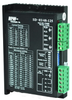
Key Features: 20 to 50 VDC Supply Voltage. H-Bridge, 2 Phase Bi-polar Micro-stepping Drive. Suitable for 2-phase, 4, 6 and 8 leads step motors. Compatible with all H2W linear stepper motor models, STS-0213-R, STS-0620-R, STS-1220-A, STS-2030-A. Compatible with standard rotary stepper motors used in... [See More]
- Features: Alarm / Status Monitoring; Other; Over Voltage, Coil to Coil, and Coil to Ground Short Circuit Protection
- Motor / System: Bipolar; Microstepping Motor
- Axes: 1.0
- DC Input: 20 to 50
from Sanyo Denki America, Inc.
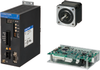
5-Phase stepping driver with micro-step function. [See More]
- Features: Alarm / Status Monitoring
- AC Input: 200 to 230
- Motor / System: Full-Step; Half-Step; Microstepping Motor
- Phase : Single Phase

from Aerotech, Inc.
Design Features. Network drives through a high-speed serial interface to coordinate up to ten axes of motion. Coordinate motion using up to five independent tasks. Drive and control linear or rotary brushless, DC brush servo, and micro-stepping motors. Command various motion types including:... [See More]
- Features: Soft Start; Limit Switch; Auxiliary I/O; Alarm / Status Monitoring
- Axes: 1.0
- Product: Controller / Drive
- Motor / System: Permanent Magnet; Hybrid; Microstepping Motor

from Aerotech, Inc.
Design Features. Single-axis digital servo controller with integral power supply and amplifier. Advanced software architecture shortens customer development time; use C#, VB.Net, C, and LabVIEW?? combined with our full IDE and multitasking operating system. Host-mode operation allows you to send... [See More]
- Features: Soft Start; Limit Switch; Auxiliary I/O; Alarm / Status Monitoring
- Axes: 1.0
- Product: Controller / Drive
- Motor / System: Permanent Magnet; Hybrid; Microstepping Motor