
Retaining Rings and Snap Rings Information
Last revised: January 10, 2025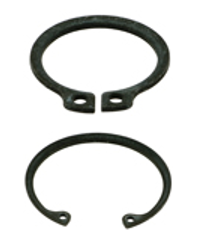
Retaining rings and snap rings are fasteners used to axially position a component on a shaft or in a bore.
Types
The primary retaining ring type can be internal or external. Internal retaining rings fit into a housing or bore. External retaining rings fit over a shaft or pin.
The retaining ring style can include any of the following.
- Circlip are the most common style for axial installation, usually has ears with holes for assembly tool.
- Radially assembled include E-style and other radially installed rings (external only). These rings are also called snap-on style.
- Wire formed rings are of uniform cross section with no ears. They are also called "Eaton" style.
- Grooveless retaining rings do not require a groove. They often have prongs that grip shaft or housing bore. These rings are also called self-locking.
- Spiral retaining rings are coiled, flat rings with no gap or protruding ears.
- Beveled retaining rings are used for endplay take-up; the ring has beveled angle (usually 15°). The beveled angle on the ring mates to a complimentary angle on the groove wall during installation, creating a rigid assembly.
- Bowed retaining rings are used for endplay take-up; bowed or curved, includes EL type. Bowed rings exert a pre-load on the assembly and act like a spring, keeping the assembly in compression.
- Interlocking retaining rings have two identical, interlocking halves (external only). They are installed radially.
Design units for retaining rings and snap rings can be English or metric. Some suppliers may specify both.
Specifications
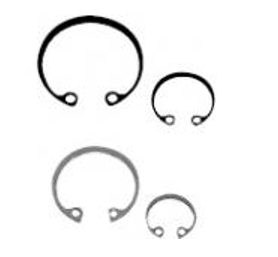
Important size specifications to consider when searching for retaining rings and snap rings include:
- The shaft diameter — Specified for external rings.
- The housing diameter — Specified for internal rings.
- The maximum thrust load — Also called the ring shear.
Common materials of construction for retaining rings and snap rings include:
- Beryllium copper — Chosen when the ring is required to conduct electricity.
- Spring steel — The most commonly used material.
- Stainless steel — Includes steel alloys, bronze and plastics.
Common finish, coating or plating for spring steel retaining rings and snap rings are:
- Oil dip
- Phosphate coating
- Zinc plating
- Zinc dichromate lacquer
- Black oxide
- Cadmium plating
Common treatment for stainless steel is passivation.
Standards
ADS AS20760-766 — Ring, retaining
JDT871 — Specifications for snap rings
Retaining Rings and Snap Rings FAQs
How do different types of retaining rings and snap rings vary in terms of their applications?
Different types of retaining rings and snap rings vary in their applications based on their design and functionality. Here are some insights into how they differ:
Constant Section Retaining Rings
These rings have a uniform, constant section that provides three-point contact with the groove. They are often used in applications where consistent pressure distribution is needed, such as in heavy-duty applications that require high strength and stability.
Tapered Section Retaining Rings (Circlips)
Tapered section rings grip the entire periphery of the groove along the ring’s edge, providing secure and reliable retention. They are commonly used in applications where a strong grip and secure assembly are required, such as in automotive and industrial machinery.
Spiral Rings
Spiral rings are wound from a single section of flat wire and provide 360-degree axial contact. They are suitable for applications that require a complete and uniform contact around the groove, offering a compact and efficient solution.
Radial Rings (C-Clips, E-Rings, and Poodle Rings)
These rings are designed for installation directly in place onto the groove without expansion over the shaft. They are used in applications where simplicity and ease of installation are important, such as in securing components on shafts.
Bowed and Beveled Retaining Rings
These rings offer endplay take-up, minimizing space between components caused by tolerance variations. They are used in applications where maintaining tight component assembly is crucial.
Snap Rings
Snap rings are extensively used in the off-highway, agricultural equipment, and automotive industries for securing piston pins, clutch assemblies, and suspension components. They are also used in industrial machinery and appliances to hold components like bearings and gears in place, especially under impact loading conditions.
How do retaining rings compare to other fastening solutions in terms of cost and efficiency?
Retaining rings generally provide a more economical fastening solution due to lower hardware costs and reduced labor expenses. They eliminate the need for complex shaft or housing preparations such as threading, tapping, and drilling, which can significantly lower fabrication time and costs.
They often result in a smaller finished design footprint with reduced weight. A single retaining ring can replace multiple pieces of hardware in an assembly, contributing to a more streamlined and lightweight design.
Retaining rings, such as snap rings, can be easily installed without special tools, although some configurations have notches for easier installation. This simplicity allows for flexible production assembly and can be automated, enhancing efficiency in manufacturing processes.
Retaining rings are versatile and can be used in various applications, including automotive, industrial machinery, and appliances. They are particularly effective in heavy-duty applications requiring high strength and stability, providing consistent pressure distribution.
What are the limitations of using retaining rings compared to other fastening solutions?
Retaining rings, while offering several advantages, also have certain limitations compared to other fastening solutions. Here are some insights based on the information available:
Load Capacity and Strength
Retaining rings may not provide the same load-bearing capacity as some traditional fasteners like bolts or screws. In applications requiring high tensile strength or shear resistance, retaining rings might not be the optimal choice.
Precision and Tolerance
The effectiveness of retaining rings can be influenced by the precision of the groove in which they are installed. Any deviation in groove dimensions can affect the performance and reliability of the retaining ring.
Installation Requirements
Although retaining rings are generally easy to install, certain types may require specific tools or notches for proper installation, which could complicate the process in some scenarios.
Limited Application Scope
Retaining rings are primarily used for axial retention and may not be suitable for applications requiring radial or multi-directional fastening solutions. Their use is often limited to specific applications like securing components on shafts or within housings.
Material and Environmental Constraints
The material of the retaining ring must be compatible with the environmental conditions of the application. For instance, in corrosive environments, special materials or coatings may be necessary, which could increase costs.
These limitations highlight the importance of selecting the appropriate fastening solution based on the specific requirements of the application, considering factors such as load, environmental conditions, and installation constraints.
How do the installation methods of retaining rings differ from other fasteners?
The installation methods of retaining rings differ from other fasteners in several ways, offering unique advantages and considerations.
Ease of Installation
Retaining rings, such as snap rings, can be easily installed without the need for special tools, although some configurations have notches for easier installation. This contrasts with traditional fasteners like bolts or screws, which often require tools such as wrenches or screwdrivers.
Design Simplicity
Unlike other fasteners that may require complex shaft or housing preparations such as threading, tapping, and drilling, retaining rings eliminate these needs, leading to lower fabrication time and costs.
Installation Method
Radial rings (e.g., C-Clips, E-Rings) are designed for direct installation onto the groove without expansion over the shaft, providing a straightforward solution for securing components. This differs from axially installed fasteners, which may require alignment and threading.
Automation Potential
The simplicity of retaining rings allows for flexible production assembly and can be easily automated, enhancing efficiency in manufacturing processes.
Precision Requirements
The effectiveness of retaining rings can be influenced by the precision of the groove in which they are installed. This precision requirement is less of a concern for some traditional fasteners, which can accommodate a wider range of tolerances.
These differences highlight the unique benefits of retaining rings in terms of installation simplicity and cost-effectiveness, especially in applications where reduced weight and streamlined assembly are desired.
What are the advantages of using retaining rings over traditional fasteners?
Retaining rings offer several advantages over traditional fasteners, making them a preferred choice in many engineering applications. Here are some key advantages:
Retaining rings generally provide a more economical fastening solution due to lower hardware costs and reduced labor expenses. They eliminate the need for complex shaft or housing preparations such as threading, tapping, and drilling, which can significantly lower fabrication time and costs.
They often result in a smaller finished design footprint with reduced weight. A single retaining ring can replace multiple pieces of hardware in an assembly, contributing to a more streamlined and lightweight design.
Retaining rings, such as snap rings, can be easily installed without special tools, although some configurations have notches for easier installation. This simplicity allows for flexible production assembly and can be automated, enhancing efficiency in manufacturing processes.
Retaining rings are versatile and can be used in various applications, including automotive, industrial machinery, and appliances. They are particularly effective in heavy-duty applications requiring high strength and stability, providing consistent pressure distribution.
What are the installation methods for different retaining rings?
The installation methods for different retaining rings vary based on their design and application requirements. Here are some insights into the installation methods for various types of retaining rings:
Constant Section Retaining Rings
These rings are typically installed by expanding them over the shaft and then allowing them to contract into the groove. They provide three-point contact with the groove, ensuring stability and strength.
Tapered Section Retaining Rings (Circlips)
Tapered section rings, also known as circlips, are designed to grip the entire periphery of the groove. They often feature lugs and lug holes, which facilitate easy installation and removal using circlip pliers.
Spiral Rings
Spiral rings are wound from a single section of flat wire and provide 360-degree axial contact. They are installed by winding them into the groove, offering a compact and efficient solution.
Radial Rings (C-Clips, E-Rings, and Poodle Rings)
These rings are designed for direct installation onto the groove without expansion over the shaft. Their open-ended design allows them to be placed directly into the groove, providing a straightforward solution for securing components.
Bowed and Beveled Retaining Rings
These rings are installed similarly to other retaining rings but offer additional benefits such as endplay take-up, which minimizes space between components due to tolerance variations.
Snap Rings
Snap rings can be easily installed without special tools, although some configurations have notches for easier installation. This simplicity allows for flexible production assembly and can be automated, enhancing efficiency in manufacturing processes.
Retaining Rings and Snap Rings Media Gallery
References
GlobalSpec—Retaining Rings Make Shaft-Sense
Image credits:
Applied Industrial Technologies | MISUMI USA
- circlip
- industrial retaining ring co
- piezometer ring
- 316 stainless steel snap rings
- generator retaining rings
- industrial retaining rings
- internal snap rings
- metric retaining rings
- retaining ring catalog
- round wire retaining rings
- snap-in hole plug stainless
- spiral retaining rings
- 316 stainless steel retaining rings
- circular cross section retaining rings
- e retaining rings
- grease retaining rings
- heavy duty internal retaining rings
- laminar seal ring
- large snap rings
- metric round wire snap rings
- metric spiral internal retaining rings
- miniature snap rings
- push on external retaining rings
- roller bearing snap rings
- standard retaining rings
- thin section retaining rings
- threaded retaining rings
- thrust load retaining rings
- transmission snap rings
- turbo generator retaining rings