
Studs Information
Last revised: January 17, 2025
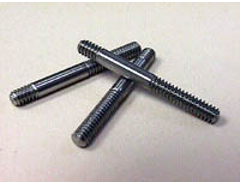
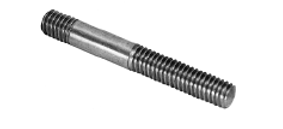
Studs are mechanical fasteners which are threaded on one or both ends. One end is secured to an object. The other end is used typically with a nut. Studs are available in both English and Metric threads.
Materials
Studs can be anodized, coated with phosphate or black oxide, chrome galvanized, or plated with gold, nickel, silver, tin, zinc, or zinc chromate.
Metallic
Aluminum is malleable, ductile, light, and trivalent with good electrical and thermal conductivity, high reflectivity, and resistance to oxidation.
Brass has good strength, excellent high temperature ductility and reasonable cold ductility, good conductivity, excellent corrosion resistance, good bearing properties and low magnetic permeability.
Bronze is a metal composed of copper as the main alloying metal and one or more other metals, such as tin, zinc, or phosphorus. Silicon bronze is a typical stud alloy.
Copper is a reddish metallic element that is ductile and malleable and is one of the best conductors of heat and electricity. Copper also exhibits good corrosion resistance.
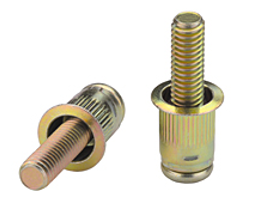
Titanium is hard, light, strong and corrosion-resistant. Titanium studs are used widely in the aerospace industry and in medical applications, such as replacement joints.
Steel studs are made from iron that contains carbon in any amount up to about 1.7 percent as an essential alloying constituent. Many grades of carbon and alloy steel are used as fastener materials. Some grades must be coating to protect studs against corrosion. Others, such as stainless steel studs, are chemical and corrosion resistant, and can have relatively high stress ratings.
Many different grades of stainless steel are used in fasteners such studs; however, stainless steels cannot be hardened to the same degree as carbon steels. Consequently, hardened steel is another common material choice for metal studs.
Specialized and proprietary materials for metal studs include Inconel and Incoloy, alloys which combine good strength and excellent resistance to oxidation and carbonization in high temperatures and many aqueous environments. Inconel and Incoloy, registered trademarks of Special Metals Corporation, are generally used at service temperatures below 650°C (1200°F).
Monel is an alloy with high strength and resistance to a range of corrosive media including seawater, hydrofluoric and sulfuric acids, and alkalis. Monel is also registered trademark of Special Metals Corporation.
Non-metallic
- Plastic
- Fiber-reinforced plastic
- Nylon
- Polyvinyl chloride (PVC)
- Polyvinylidene fluoride (PVDF)
- Polytetrafluoroethylene (PTFE)
- Synthetic rubber
Standards
ADS AGS883—4 inch studs
ASME B18.31.2—This Standard covers the complete dimensional and general data for continuous thread and double-end inch-dimensioned studs recognized as American National Standard.
Studs FAQs
What are the key factors to consider when selecting the right type of stud for a specific application?
When selecting the right type of stud for a specific application, several key factors should be considered:
Material Compatibility: The material of the stud should be compatible with the materials it will be joining. This ensures proper bonding and prevents issues like corrosion or material degradation. For example, aluminum studs are covered under AWS D1.2 but are not typically used in composite construction.
Application Requirements: Different applications may require different types of studs. For instance, capacitor discharge stud welders are suitable for smaller elements and non-standard base materials, while arc stud welders are better for larger diameter fasteners and structural purposes.
Load Conditions: Consider the load conditions the stud will be subjected to. For cyclically loaded applications, studs should be tested and furnished in the annealed condition to ensure durability and performance.
Welding Process: The welding process can influence the choice of stud. For example, drawn arc stud welding requires ceramic ferrules to properly weld the studs and protect the molten metal from contamination.
Standards and Codes: Compliance with relevant standards and codes is crucial. For example, the American Welding Society (AWS) D1.1 Structural Welding Code—Steel lists different types of studs based on their use, such as Type B weld studs for shear transfer in composite construction.
How does the choice of welding process affect stud selection?
The choice of welding process significantly affects stud selection due to several factors related to the application and the characteristics of the welding methods. Here are some key considerations:
Type of Welding Process
Capacitor Discharge Stud Welding: This process is ideal for smaller elements such as small-diameter studs or pins. It is also suitable for non-standard base materials and offers high accuracy.
Arc Stud Welding: This method is better suited for larger diameter fasteners and structural purposes. It requires ceramic ferrules to properly weld the studs and protect the molten metal from contamination.
Material and Application Compatibility
The material of the stud and the base material must be compatible with the chosen welding process. For example, aluminum studs are covered under AWS D1.2 but are not typically used in composite construction.
Load Conditions and Standards
The welding process should be selected based on the load conditions the studs will face. For cyclically loaded applications, studs should be tested and furnished in the annealed condition.
Compliance with relevant standards, such as the AWS D1.1 Structural Welding Code—Steel, is crucial. This code lists different types of studs based on their use, which can influence the choice of welding process.
Equipment and Accessories
The size and type of studs can impact the initial cost of the welding equipment and its portability. Specialized equipment and accessories may be required for certain applications, such as welding very large studs.
These factors highlight the importance of carefully selecting the welding process to ensure the studs meet the specific requirements of the application.
How do ceramic ferrules function in the arc stud welding process?
Ceramic ferrules play a crucial role in the arc stud welding process. Here are the key functions they perform:
Crucible Function: Ceramic ferrules act as a crucible to hold the molten metal around the base of the stud during the welding and cooling process. This containment is essential for forming a strong and consistent weld.
Protection from Contamination: They shield the molten metal from contamination by air. Exposure to air can adversely affect the quality of the weld by introducing impurities, so the ferrule's protective role is vital for maintaining weld integrity.
Variety of Shapes and Sizes: Ferrules come in many different shapes and sizes, each specifically designed for various stud welding applications. This variety ensures that the ferrules can accommodate different stud sizes and welding conditions effectively.
These functions highlight the importance of ceramic ferrules in ensuring the quality and reliability of welds in the arc stud welding process.
What are the different types of studs used in welding?
When it comes to welding, there are several types of studs used, each designed for specific applications and requirements.
Type A Studs
These are general-use studs for purposes other than shear transfer in composite construction. They are not covered in detail in the provided documents but are recognized in the AWS D1.1 Structural Welding Code—Steel.
Type B Weld Studs
These studs have a formed head and are commonly used for shear transfer in composite construction. They are one of the most prevalent types of studs used in structural applications.
Type C Deformed Bar Anchor Studs (DBAs)
These studs are also widely used in structural applications. They are designed to provide a strong bond and are typically used in applications requiring shear transfer.
Capacitor Discharge Studs
These are smaller diameter studs or pins used with capacitor discharge stud welding processes. They are suitable for non-standard base materials and offer high accuracy.
Arc Studs
These are larger diameter fasteners used in arc stud welding processes, suitable for structural purposes. They require ceramic ferrules for proper welding and protection of the molten metal.
These types of studs are selected based on the specific requirements of the application, including material compatibility, load conditions, and compliance with relevant standards.
How do deformed bar anchor studs differ from other types of studs?
Deformed bar anchor studs (DBAs) differ from other types of studs primarily in their design and application. Here are the key differences:
Design and Structure
Deformed bar anchor studs are specifically designed with deformations or ridges along their length. These deformations help in providing a stronger mechanical bond when embedded in concrete or other materials, enhancing their anchoring capability.
Application
DBAs are commonly used in structural applications where a strong bond is required, such as in shear transfer applications. They are particularly effective in situations where the stud needs to be embedded in concrete to provide additional strength and stability.
Comparison with Other Stud Types
Type A Studs: These are general-use studs not specifically designed for shear transfer in composite construction.
Type B Weld Studs: These have a formed head and are also used for shear transfer in composite construction, but they do not have the deformations characteristic of DBAs.
Capacitor Discharge Studs: These are typically smaller diameter studs used with capacitor discharge welding processes, suitable for non-standard base materials and offering high accuracy.
Arc Studs: These are larger diameter fasteners used in arc stud welding processes, suitable for structural purposes, but they do not have the specific deformations of DBAs.
These differences highlight the specific use cases and advantages of deformed bar anchor studs in providing enhanced bonding and structural integrity in certain applications.
What are the advantages of using deformed bar anchor studs over other types of studs in construction?
DBAs offer several advantages over other types of studs in construction, particularly due to their design and application. Here are some key advantages:
Enhanced Mechanical Bond
DBAs are designed with deformations or ridges along their length, which provide a stronger mechanical bond when embedded in concrete or other materials. This design feature enhances their anchoring capability, making them particularly effective in applications requiring shear transfer and structural integrity.
Structural Applications
DBAs are commonly used in structural applications where a strong bond is essential. Their deformed design allows for better mechanical interlock with concrete, improving the overall structural integrity and stability of the construction.
Shear Transfer
In composite construction, DBAs facilitate shear transfer between concrete and steel structures. Their deformations allow for a better mechanical interlock with the concrete, which is crucial for distributing loads and providing additional strength.
Comparison with Other Stud Types
Unlike Type A studs, which are general-use and not specifically designed for shear transfer, DBAs are tailored for applications requiring enhanced bonding. Type B weld studs, while also used for shear transfer, do not have the deformations characteristic of DBAs, which provide the additional mechanical grip.
These advantages make deformed bar anchor studs a preferred choice in construction applications where enhanced bonding and structural integrity are critical.
Studs Media Gallery
References
Image credits:
Berg W.M., Inc. | PennEngineering | Jergens, Inc.
- # 0
- # 10
- # 12
- # 14
- # 16
- # 18
- # 2
- # 20
- # 24
- # 3
- # 4
- # 5
- # 6
- # 7
- # 8
- # 9
- 1 1/4"
- 1 1/8"
- 1"
- 1/2"
- 1/4"
- 3/4"
- 3/8"
- 5/16"
- 5/8"
- 7/16"
- 7/8"
- ASME / ANSI
- Aluminum
- Black Oxide
- Brass
- Bronze / Copper Base Alloy
- Copper
- DIN
- Galvanized
- Hardened Steel
- Hex
- ISO
- M 2.5
- M10
- M12
- M16
- M20
- M24
- M3
- M3.5
- M4
- M5
- M6
- M8
- Nickel Plated
- Nylon
- Plastic
- Pressed
- Round
- Rubber
- SAE
- Stainless Steel
- Steel
- Threaded
- Welded
- Zinc Plated
- ball stud
- PVC stud
- rubber stud
- threaded ball studs
- 20 gauge steel studs
- 4-40 threaded studs
- 8x1.25 studs
- accelerometer mounting studs
- aluminum 2x4 studs
- b7 thread studs
- bumpers with threaded studs
- copper ground studs
- corrosion resistant metal studs
- double end threaded studs
- electrical grounding studs
- hardened threaded ball studs
- hot dipped galvanized studs
- m10x1.25 studs
- m6 threaded studs
- metric weld studs
- molded threaded studs
- press fit threaded studs
- projection weld studs
- rubber bumpers with threaded studs
- sa193 b7 studs
- self clinching studs
- self tapping carbide tire studs
- stainless steel exhaust manifold studs
- stainless steel nelson studs
- stainless steel wheel studs